
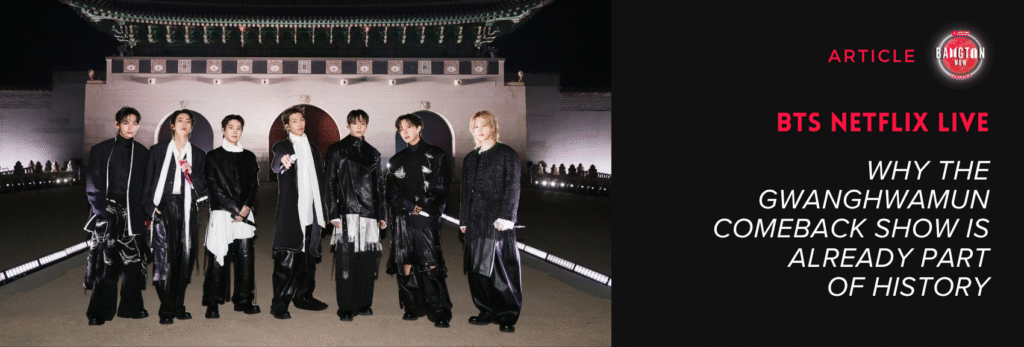
With their BTS Netflix live, the group turned their return into a spectacle about identity, history, and connection with ARMY.
Standing before a historic gate, in one of Seoul’s most symbolic spaces, the anticipation wasn’t just for a show – it was for the return of 7 kings. Nearly four years after their last full-group performance, BTS was back on stage together, streaming live on Netflix to 190 countries simultaneously.
From the very first seconds, it was clear: this wasn’t just a comeback. It was a statement.
In this article, we’re going to walk you through everything that happened on that stage – including details you might have missed, because let’s be honest, the emotions in the moment are overwhelming. We get it, because we were there too, and it’s only afterwards, with a clearer head, that you actually have time to stop and look things up… phew!
But first, some context, right? Let’s go!
What was the Netflix BTS | ARIRANG live?
Held on March 21, 2026, BTS THE COMEBACK LIVE | ARIRANG marked the group’s first full performance after their hiatus for mandatory military service.
The stage was set up at Gwanghwamun Square in Seoul, with an in-person crowd of over one hundred thousand people and a live stream on Netflix reaching 190 countries – with an estimated audience of 300 million viewers, not counting everyone who will watch the recording (like us, on repeat…).
As with everything surrounding this comeback, the numbers were astronomical almost immediately. According to global streaming rankings site FlixPatrol, it hit #1 in the films category on March 22nd, reaching the top spot in 77 countries.
BTS THE COMEBACK LIVE | ARIRANG became one of the biggest events ever streamed on Netflix, reaching 18.4 million viewers (Live+1). It outperformed every major awards show recently streamed on the platform:
- BTS THE COMEBACK LIVE | ARIRANG — 18.4M
- Oscars — 17.9M
- Grammys — 14.4M
- Golden Globes — 8.6M
- Emmys — 7.4M
- VMAs — 5.5M
It also made history as the biggest live music event by an artist on Netflix and the 4th biggest live event on the platform overall, behind only Jake Paul vs. Mike Tyson (108M), Crawford vs. Canelo (41.4M), and Jake Paul vs. Anthony Joshua (33M).
The production carried serious weight behind the scenes: executive director Hamish Hamilton, known for the Super Bowl Halftime Show – the largest live event in the world – and the opening and closing ceremonies of the 2012 London Olympics. Producer Guy Carrington, who directed the 2020 Emmy Awards, rounded out the team.
Running about an hour, the BTS Netflix live served as the official introduction to the group’s new era and their album ARIRANG, released just one day earlier. More than a music promotion, BTS used the stage to present a concept – and a very clear artistic vision of who they are right now.
Why Gwanghwamun was the perfect stage for this comeback
Gwanghwamun is not just a square. It’s a space where Korean history, political power, and cultural memory converge. By choosing this location as the stage for the BTS Netflix live, the group shifted the comeback away from the usual entertainment territory and into the symbolic.
Korea JoongAng Daily noted that the show’s production was designed to “engage with the historic space, framing the Gwanghwamun gate and the mountains in the background as part of the spectacle’s visual narrative.” The setting wasn’t meant to be backdrop – it was an active element of the story.
The contrast between the historic gate and the stage’s technological structure created a powerful image: tradition and modernity not in opposition, but in continuity.
ARIRANG isn’t just an album title: it’s the key to the BTS Netflix live concept
“Arirang” is one of Korea’s oldest folk songs, carrying themes of longing, separation, and national identity.
Want to know everything about ARIRANG, the album? Read our full article here.
Netflix described the concept of the BTS Netflix live as a conscious effort to “translate the group’s Korean identity into a global language without losing cultural specificity,” pointing to the ARIRANG album as the emotional backbone of the show.
On stage, “Arirang” functions less as a literal reference and more as a narrative structure: the return after absence, the crossing of time, the reconnection with the audience.
BTS didn’t just put on a show: they told a story in acts
If you’ve read our articles on j-hope, Jin, and SUGA’s solo shows, you already know BTS doesn’t do a show without telling a full story – beginning, middle, and end.
And this was no different, of course!
The BTS Netflix live was structured as a three-act narrative, with a striking, symbolic opening.
Each block of the show responds to and builds on the previous one – not just musically, but emotionally – through lighting, special effects, and even the costumes.
Act 1 (Opening): The Calling
The sounds of traditional Korean instruments and ancestral chants slowly blend with contemporary beats, creating a mysterious atmosphere that takes over Gwanghwamun Square. The BTS Netflix live is beginning like a ritual.
Aerial shots show the Square. The transition is symbolic – from the ancient palace arches to the geometric portal, built in just a few breathtaking days, framing modern Seoul in the distance.
On screen, the words: “BTS The Comeback Live | Arirang.”
Are you ready? Nobody is.
Traditional chants mix with heavy beats. Under Seoul’s dark sky, masked dancers dressed in black emerge like guardians of the night, heralding the return of the 7 kings. Then he – the leader – steps forward and says: “Hello, Seoul. We’re back.”
The first song on the setlist: Body to Body, from the new album – itself a fusion of Korean culture and cutting-edge sound. The most perfect, most impactful choice possible.
The portal, sober and lit in grey, is the ideal frame for the jaw-dropping choreography. Everything was designed for maximum impact: set design, lighting, special effects – and don’t even get us started on the costumes. They’re so special we’ll get to them later in detail, because they’re not just beautiful – they tell a story too.
This is BTS telling the entire world they are deeply, proudly Korean. And as if that weren’t enough, in comes a live choir performing the folk song Arirang – woven into Body to Body – with traditional singers and musicians. Absolutely spine-tingling.
A Fun Choreography Note: Our leader RM, who really should have been taking it easy, could not stop jumping!
Let me explain: just one day before the show, RM injured his ankle and had to wear a medical boot. Nothing serious, but it does require some care. Did that stop him? Despite the chair placed on stage for him, there he was, jumping away. Kim Namjoon being Kim Namjoon – much to his orthopedist’s despair, poor thing!
For most of the other songs – okay, not all of them – he did mercifully stay a little calmer, under the watchful, caring eyes of the Bangtan boys.
Onwards…
Act 2: Identity – who is BTS now?
After that thunderous opening, the BTS Netflix live moves into thematic blocks, the first of which explores the identity BTS is currently building.
The block opens with Hooligan – the portal bathed in red, masked dancers filling the stage. Everything is intense and dense, from the choreography to RM’s dragon claw-shaped microphone.
Then comes 2.0.
Even seated because of his injury, RM follows the choreography as best he can, and the group doesn’t adapt the dance around him – they simply leave his space open on stage. Beautiful to witness.
And what a choreography it is. The domino effect is absolutely insane and works incredibly well at that scale. We need the practice dance video, like, yesterday.
After this block, BTS takes a brief pause to talk to the crowd – and can we also take a quick second to talk about Jimin’s hair? Okay… focus, focus!
SUGA thanks the audience and says:
“It’s a great honor to perform here at Gwanghwamun, one of the most historic places in Korea. We wanted this album to reflect who we are. That’s why we chose ARIRANG as the title – and with that in mind, we’re performing here at Gwanghwamun.”
V adds:
In a place like this, it really is deeply emotional to make our comeback.”
j-hope and Jungkook thank everyone in English – both those there in person and those watching live. The next block, about BTS in the world, is about to begin.
Act 3: Expansion – BTS goes global
The arrival of BTS’s biggest hits brought scale, energy, and collective recognition. Here, BTS proves itself a global phenomenon without abandoning the show’s conceptual core.
Next up? The song that cemented BTS as the greatest live performance in Grammy history: Butter – an absolute worldwide smash. Nam doesn’t stop spinning in his little chair, and the most wonderful thing is watching the Bangtan boys dancing and playing around him.
Less festive but equally global is the absolute banger Mic Drop – and honestly, we waited four years to see Yoongi drop that microphone on stage again. WOW.
A brief pause for BTS to chat with the crowd about the ARIRANG album, and then…
Act 3 – Part 2: BTS global, today
Where Butter and Mic Drop remind us what made BTS global, this next section lays the foundation for what will make BTS global in this new era: BTS 2.0.
Starting with Aliens.
And it couldn’t be more meaningful. In Aliens, BTS uses the metaphor of being “aliens” to express how they feel different – and at the same time, special – in the global music landscape. “If you want to come into my house, take your shoes off.”
The grey portal fills with intense red lights, dancers complement the stage. Everything is powerful and charged.
And before you even catch your breath, FYA sets the stage completely on fire – all 7 playing/fighting directly with the camera. Pure chaos. The best kind.
Jungkook had mentioned in a previous interview that he was nervous to perform this song live. Right after FYA, he says:
“That was so fun! Playing these songs for the first time is nerve-wracking, but it’s so exciting – it feels so new. It’s been a while. It’s electric!”
Jin adds:
“We’ve been away for so long, we’re so pumped. Before we went on, I said: ‘We’re shaking right now, but once we get on stage, we’re going to drop a Mic Drop.’ And then Mic Drop flew by too. The energy is incredible. I’m so moved that you loved the new songs.”
j-hope:
“The energy is amazing and I’m so pumped. This album has songs in so many different styles. These songs hold so much of what we’ve been thinking. Honestly, while we were putting this album together, we were really anxious – wondering whether people would still be waiting for us, or whether they’d already moved on (Editor’s note: the crowd loudly protests). Yeah. We were worried about that.”
SUGA:
“During this time when we had to stop, we kept asking ourselves what we should keep the same and what we needed to change. We still don’t have all the answers, and the anxiety still comes back sometimes – but I think even those feelings are part of who we are.”
RM:
“At this crucial moment, we kept asking ourselves what choices to make and how we wanted to be remembered as artists. In the end, we realized the answer wasn’t outside of us – it was within. We decided to listen to our own voices and embrace those thoughts and doubts, rather than hide them. I think that’s what this album was about: sharing that.”
Jimin:
“As you all know very well, we’re not special or extraordinary people (Note: the crowd strongly disagrees, and Jimin plays with them in the most hilarious way before continuing). Just like you, we have fears and worries. We were anxious about preparing this show – but despite that, we want to embrace those feelings and keep swimming together. We believe that, one day, we’ll be able to get through anything.”
V:
“I think all we can do is keep moving forward, one step at a time, without stopping. We’ll keep releasing music, doing shows, and giving everything we have for you, ARMY. I think that’s our role, and that’s how we’ll continue. I hope this next song brings at least a little comfort and strength.”
These words aren’t incidental. They are a declaration of principles for BTS 2.0.
And the BTS Netflix live continues as a gift to ARMY with the title track from ARIRANG: SWIM.
We then see it for the very first time – the long-awaited choreography. It merges organically, with fluid movements, as the portal shifts to blue and shows wave-like forms. It’s like dreaming with your eyes open. “I could spend my whole life just watching you.”
You haven’t even dried your tears yet when Bangtan settles onto the steps of the stage, under the grey portal, to perform the devastating Like Animals.
Yoongi goes full emo heartbreak mode as he joins the vocal line properly, while Jin sings like a siren casting a spell over every single ARMY. Like Animals live is a full sensory assault.
Normal follows immediately after, closing BTS’s emotional declaration. They are back – and they mean business.
Act 4: Connection – the reunion with ARMY
After reaching deep into our emotions, BTS closes the show with heartfelt words – and it couldn’t be any other way.
The finale is all about connection, and the songs chosen celebrate that bond between fandom and group.
It starts with the one that united people across the world: the eternal Dynamite – a pure celebration. But the real gut-punch comes with the always emotional Mikrokosmos. Together, they seal the pact: after the absence, the reunion.
BTS The Comeback Live | Arirang ends there – but really, it’s only the beginning of BTS 2.0, and we all know it.
Hold on though, there’s still more. There are some details that we thought we caught, but didn’t quite see clearly enough.
The costumes of the BTS Netflix live: armor, poetry, and Korean identity on stage
If you thought the members’ looks were just aesthetics, we need to talk. The costumes for the BTS Netflix live were treated as a central part of the show’s concept – and it’s no exaggeration to say that each piece was telling a story before a single note was played.
The exclusive collection was designed by Korean designer Jay Songzio of the brand SONGZIO, and was given the name Lyrical Armor.
The inspiration came from traditional Korean clothing and the armor of the Joseon era, reinterpreted through sculptural silhouettes and a predominantly monochromatic palette. But the real creative turning point was the tension between strength and fluidity: “They wanted something more fluid. So the challenge became how to blend this armor concept with lightness,” Songzio told WWD in an interview published on the day of the show.
That’s where the hanbok came in – light, fluid, with a natural drape – combined with armor details to create something entirely new.
There was clear intention behind the brand choice too. BTS wanted a genuinely Korean fashion house – not just in nationality, but in aesthetic. “Since I always seek to highlight that Korean identity in my work, I think it was a very natural fit,” said the designer.
The emotional starting point was the concept of han – that deeply Korean feeling of sorrow and longing that carries through generations – and from that, each member became a heroic figure within a larger visual narrative.
And here’s where it gets even more beautiful: each of the seven received their own archetype within this visual story.
🐨 RM / hero – Inspired by the image of classic heroes, reinterpreted through a modern Korean silhouette. Structural elements and proportions reinforce a strong, symbolic presence on stage.
🐹 Jin / artist – Rooted in Joseon-era aesthetics and traditional elements, translated into a contemporary reading. Represents an artistic figure that balances delicacy and strength.
🐿️ j-hope / narrator – Inspired by the modern MA-1 jacket, reinterpreted with volume and style. The piece reflects a dynamic, expressive presence as the story’s narrator.
🐱 SUGA / architect – A structured, technical composition with a solid silhouette and layered details. Represents emotional depth and sonic construction.
🐻 V / noble – Visually inspired by traditional figures, with wide, dramatic shapes. Creates a striking, commanding silhouette.
🐥 Jimin / poet – Fluid lines and traditional elements combined with modernity. Represents sensitivity and artistic expression.
🐰 Jungkook / pioneer – A mix of modern and traditional elements, with an emphasis on texture and movement. Represents progress and energy.
The process was far more collaborative than anyone might have expected. “At first, I didn’t anticipate that level of involvement,” Songzio admitted. “They participated a lot, down to the smallest details – like colors and accessories.”
The behind-the-scenes moments prove it: the night before the show, Jungkook asked for his white shirt to be painted in a rawer style, inspired by Korean landscape painting. Jimin incorporated black onyx pieces and metallic details into his look.
And since there was no room for traditional quick-changes on an open-air stage like Gwanghwamun, some costumes were built with up to five layers – which the members peeled back throughout the performance, creating a visual transformation in real time.
In the end, what we saw on that stage wasn’t just clothing. It was concept, narrative, and Korean identity – literally sewn together until the early hours before the show.
What this comeback reveals about the group’s new chapter
After military service, BTS returns less concerned with proving relevance and more focused on affirming purpose. The posture on stage, the words spoken, and the very concept of the Netflix BTS live reveal a group that is deeply conscious of its historical position.
During BTS The Comeback Live | ARIRANG, SUGA captured the moment perfectly when he said the group wanted to show “the most honest and mature version of BTS,” explaining that ARIRANG represents identity over commercial ambition.
This is not a BTS trying to repeat formulas from the past. This is a BTS reorganizing around its own core.
BTS Netflix: more than a show, a message to the global industry
While parts of K-pop tried to go global by diluting their identity, BTS did the opposite: they went deeper into their roots and invited the world to look at them.
The Guardian noted that the show created a deliberate contrast between “palatial aesthetics, the force of EDM, and Korean folk references,” describing it as a rare example of global pop that doesn’t neutralize its cultural origins.
The message is clear: global success doesn’t come from cultural neutrality – it comes from specificity, told well.
When BTS paved the way for K-pop to become a global phenomenon, part of the industry understood the equation in an oversimplified way. International success began to be read as synonymous with cultural neutralization: English-language songs, generic aesthetics, replicable pop formulas. The result was a proliferation of comebacks that might briefly catch attention but rarely build lasting identity.
BTS themselves never claimed that the path to global reach meant abandoning their roots. Dynamite, Butter, and Permission to Dance emerged in a specific context – the pandemic – as songs of comfort, lightness, and emotional resilience. They worked because they responded to a concrete historical moment, not because they represented a new aesthetic blueprint. The industry’s mistake was to treat an exception as a model.
Before that – and after – BTS’s biggest global hits were always sung in Korean. Not by accident. What took the group to the world wasn’t an attempt to “speak to everyone,” but the ability to tell deeply localized stories in a universally understandable way. The world didn’t connect to BTS in spite of Korean culture – but because of it.
This is something K-pop seems to have forgotten in recent years. In trying to speak to the biggest market, many artists ended up speaking to no one. Aesthetic homogenization created a recurring feeling of repetition: different songs that sound the same, new concepts that feel like variations of the same mold. Not from a lack of talent or stories – they exist – but from a lack of courage to tell them from a genuinely personal perspective.
The BTS Netflix live at Gwanghwamun works, in this sense, as a corrective gesture. ARIRANG is not just a symbolic name: it’s a thesis. By deepening their roots and placing them at the center of a global stage, the group reaffirms that international relevance doesn’t come from cultural dilution – it comes from specificity, well told. Global success isn’t achieved in spite of local identity, but precisely through it.
This movement isn’t unique to BTS. Artists like Bad Bunny show the same path – singing in Spanish about the pain, love, and contradictions of Puerto Rico, and still dominating the global scene. Well-told stories cross borders because they have ground beneath them.
By coming home to speak to the world, BTS doesn’t just inaugurate a new chapter in their career. They remind the industry – and the next generation of artists – that being truly global requires, above all, being deeply true. No one builds a solid future on someone else’s story.
And as Arirang has always taught us: it is from longing, from memory, and from the crossing, that the songs which last are born.
The BTS Netflix live | ARIRANG wasn’t just a return. It was a turning point. By taking over Gwanghwamun, BTS showed that their strength lies not in adapting to the world – but in inviting the world to walk through their history.
And like every great story, this one feels like it’s only just beginning.
What was your most memorable moment from the BTS Netflix live? What moved you the most? Tell us in the comments 💜
You may also like:
 BTS Documentary on Netflix – Where to Watch BTS: The Return and What to Expect
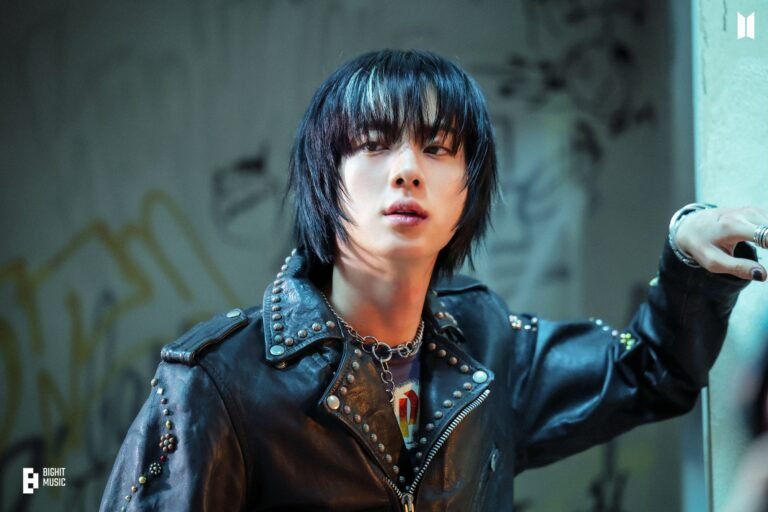 [11/05/2025] Jin to hold a special Weverse live after the release of his album “ECHO”
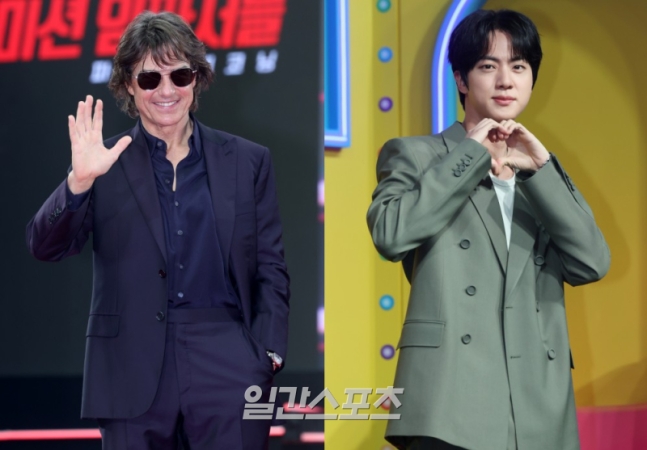 [12/05/2025] TOM CRUISE appears on “Run Jin” alongside BTS’s Jin during Korean visit
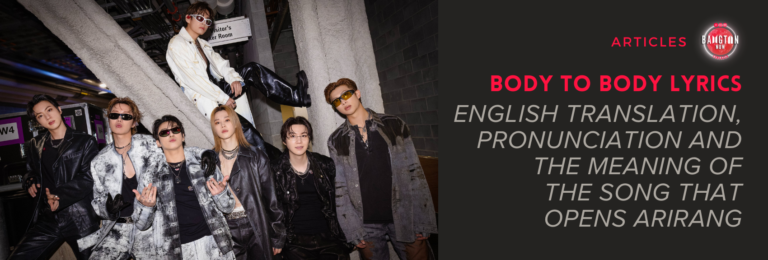 Body to Body BTS lyrics: English translation, pronunciation and the meaning of the song that opens Arirang