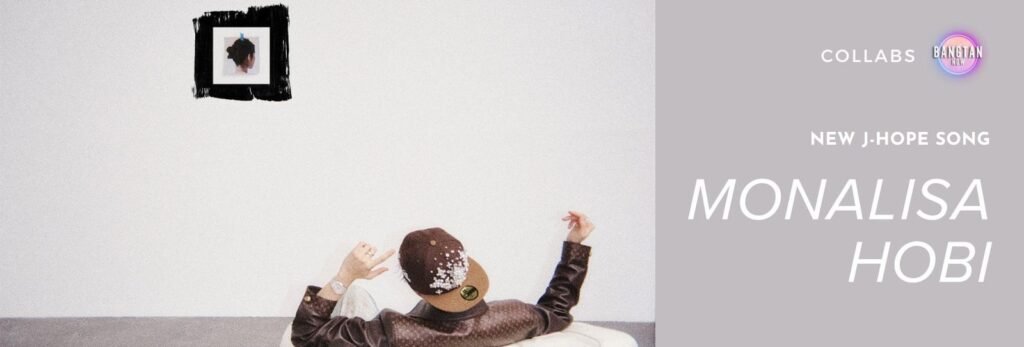
“Mona Lisa” arrived without warning and has everyone obsessed! j-hope dropped this surprise out of nowhere during his shows in Brooklyn, and fans started putting the pieces together: where did this song come from? What does it mean? When would it be officially released?
One thing is certain: nobody was ready. The crowd went wild, and what was supposed to be just another show turned into a historic moment. And as always, Hobi left clues along the way — but did anyone notice them in time?
If you want to know everything about “Mona Lisa”, stick around. We’ll talk about the song, the possible message behind it and even the details that may reveal more than we think!
j-hope’s “Mona Lisa” Lyrics
MONA LISA
(j-hope)
Chorus
I like my girls pretty, so fine
One plus the nine
How you get me goin’, might just blow it
I like my girls pretty in the face
Art piece to frame
Mona, Mona Lisa, yeah, I need ya
I like my girls
Post-Chorus
Lookin’ just like a paintin’
Don’t need no validation
Pretty, so fine
One plus the nine
How you get me goin’, might just blow it
I like my girls (Uh-huh)
I like my girls (I like, I like)
I like my girls
Verse
Independent check (Check)
Got her own check (Check)
By the way you look, yeah, you ’bout to cause a wreck
Yeah, she know I’m on the move
I can’t stop, I’m up next
But she hold me down
She’s so sexy, I’m obsessed, yeah
Toes all in the sand, come and walk with me (Walk it, walk it)
Love the way you take the stress and Louis off of me (Of me)
‘Cause she bad and she know it, yeah, that’s all I need
Earring with the diamond match her smile, yeah, she sparklin’
Pre-Chorus
Yeah, you got me all in
Bad, bad, bad, I know your exes callin’
The way you look, I understand the hype
You know you’re just my type
Gotta, gotta get ya ’cause you know just what I like
Chorus
I like my girls pretty, so fine
One plus the nine
How you get me goin’, might just blow it
I like my girls pretty in the face
Art piece to frame
Mona, Mona Lisa, yeah, I need ya
I like my girls
Post-Chorus
Lookin’ just like a paintin’
Don’t need no validation
Pretty, so fine
One plus the nine
How you get me goin’, might just blow it
I like my girls (Oh-oh-oh-oh, oh-oh-oh-oh, oh-oh-oh-oh, oh)
I like my girls (Oh-oh-oh-oh, oh-oh-oh-oh, oh-oh-oh-oh, oh)
Outro
I like my girls (Uh-huh)
I like my girls (I like, I like)
(Yeah, yeah, yeah, yeah)
Mona Lisa: The Unforgettable Surprise at HOPE ON THE STAGE
j-hope had warned there would be a surprise at the March 13 show, but nobody knew exactly what to expect. Then, during HOPE ON THE STAGE in Brooklyn, he delivered “Mona Lisa”, an unreleased track full of energy, with a catchy fusion of hip-hop and R&B. The next day he performed it again, making it clear this new era was here to leave a mark.
Before the show, he had already dropped a spoiler that went unnoticed: an Instagram story with a Mona Lisa. Without context, it looked like just a random detail — but now it all makes sense. And looking even further back, the clue was in the “Sweet Dreams” MV, where a dancing Mona Lisa appeared for anyone paying attention. But as always, details only make sense after everything happens. And we ARMYs are experts at not decoding the spoilers BTS drops, right? 😅
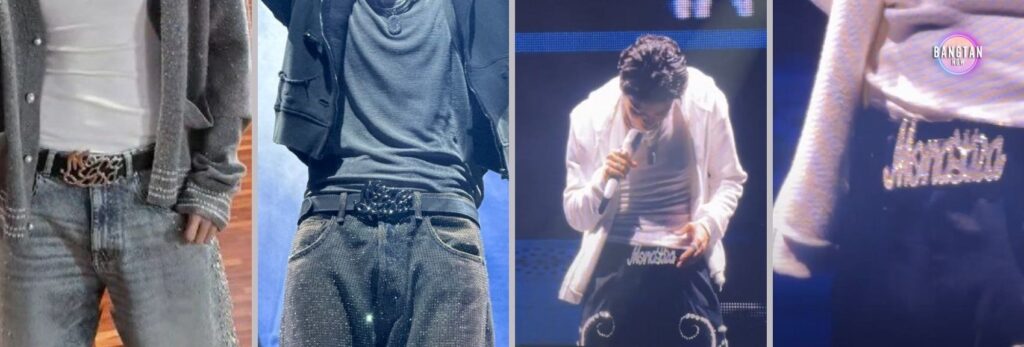
He had even posted a story in the HYBE practice room wearing a belt whose buckle read “Monalisa” but, of course, we didn’t catch the reference until he showed it at the concert. And on the second day, a second belt.
That weekend he posted a TikTok video with a snippet of the song, and the audio was quickly used thousands of times. The official release was set for March 21, 2025, at 1 PM KST. On top of that, j-hope confirmed a third song was on the way.
Lyrics Analysis: What Does j-hope Want to Say with “Mona Lisa”?
“Mona Lisa” isn’t just a song full of rhythm, sensuality and smooth flow — it carries layers of artistic and emotional meaning. j-hope blends cultural references with intense feelings, creating a track that celebrates a unique woman, compared to Leonardo da Vinci’s iconic Mona Lisa.
Speaking of which, it’s worth remembering: the Mona Lisa is considered one of the most important works in art history. Its composition is often linked to the golden ratio, a mathematical concept associated with aesthetic harmony. No wonder it became a symbol of beauty, mystery and perfection — and that’s exactly what j-hope seems to capture.
Back from his military hiatus, j-hope has been exploring a new artistic phase — bolder, more mature and, yes, more sensual. Of course that gets attention. But when it comes to art, staying on the surface is too easy. The point of an analysis like this is to go beyond the obvious. The sensuality is there, but it’s just one layer of a much more complex and interesting work.
Right from the start, j-hope sets the tone: total admiration for a type of woman — or of feminine energy — that he values and is drawn to. By speaking about “my girls” in the plural, he opens the door to a broader reading, which makes a lot of sense considering he himself said the song is for ARMY. In other words, it’s not a personal declaration to one person, but a celebration of a set of qualities he sees and admires.
The “1 plus 9” can be read as a symbolic reference to perfection — it adds up to 10, a number that represents something complete, ideal. It’s as if he were saying this kind of woman has everything he finds irresistible. And the feeling of being about to explode conveys a mix of desire, enchantment and even emotional overload.
It’s an opening that sets the song’s sensual energy, but also the tone of adoration and enchantment that repeats throughout.
A living work of art
Here j-hope makes a direct connection between the women he admires and the Mona Lisa, one of the most enigmatic and valued works in art history. But he isn’t talking only about physical beauty — he proposes an aesthetic, symbolic vision in which the woman is treated as a true work of art: unique, striking and worthy of contemplation, a face worth framing.
When he says he needs them — again in the plural — the message widens, showing he’s talking with (and about) many, maybe all, of those who identify with that energy. It’s a declaration of affection, admiration and deep connection with a femininity that inspires, enchants and commands presence.
She shines on her own
At this point, j-hope highlights a quality that goes far beyond looks: authenticity. The woman he describes is like a painting that needs no explanation — she simply is. And the strongest idea here is that she doesn’t need validation.
That line sends a clear message: she doesn’t live to please and doesn’t depend on anyone’s opinion to know her worth. In such a fast-paced world full of outside pressure, that attitude is almost revolutionary. j-hope isn’t just praising beauty — he’s celebrating confidence and the freedom to be who you are without fear of judgment.
An independent force
This is one of the most direct parts of the song, praising this woman’s independence and financial power, ticking off each item on the list. She doesn’t need anyone to support her — she pays her own way, values herself and knows her worth.
The idea that the way she looks could cause an accident suggests her presence is so striking and captivating it affects any room she walks into. She’s the person everyone notices, drawing looks without even trying.
The balance between love and ambition
Here j-hope reveals a bit of his own life: an intense routine, full of commitments, ambition and constant movement. He’s always rising, always wanting more — and that takes focus, energy and sacrifice.
But while living that rush, he recognizes there’s someone who grounds him, who brings stability and balance — someone who understands his reality and stands by him, not to slow him down but to hold him up. Then the tone shifts and the intensity grows: an almost addictive attraction that takes over body and mind.
This part clearly shows one of the song’s strengths: the mix of emotional intensity and sensuality, without losing sensitivity or falling into clichés. It’s desire, yes — but also respect and real connection.
A refuge in the middle of chaos
After portraying his busy routine and life at the top, j-hope shows a more vulnerable, intimate side. The woman is presented as a safe space, someone who offers not only company but relief and lightness amid the chaos. The image of feet in the sand evokes rest and a connection with the present and the simple.
And the line about taking the stress — and the “Louis” — off him is genius, with a well-crafted double meaning. On one hand, “Louis” refers to Louis Vuitton, the brand he’s an ambassador for, representing status, luxury and the pressure that comes with a public image. Taking off the “Louis” can mean shedding fame, demands and appearances.
On the other hand, there’s a more sensual, playful touch: the idea of literally taking off his designer clothes — with affection and, of course, obvious intent.
Either way, the message is clear: with her, he can be just Jung Hoseok, no labels, no performance, no obligations. Just himself. And maybe that’s the most intimate gesture the song reveals.
She’s everything he needs
Here j-hope goes straight to the point. No metaphors, no beating around the bush — he admires this woman for much more than her looks. She’s a baddie, and she knows it. That reinforces the image of a strong, confident woman with a striking presence. She doesn’t wait to be recognized: she already recognizes herself.
And when he says she’s all he needs, what seems like a simple phrase becomes a powerful summary of the song: this woman, with her strength, beauty and self-awareness, fills everything he values.
Her own shine
Here j-hope reinforces the image of a woman who carries value, charm and presence naturally. The diamond earring is a symbol of luxury, but placed next to her smile, what really stands out is the light that comes from within. She shines — she’s an event in herself.
j-hope isn’t saying she shines because of her jewelry. Quite the opposite: it’s her smile that makes everything around brighter. The shine here comes from confidence, authenticity and attitude — not accessories.
A breathtaking effect
Here j-hope admits it without fear: he’s completely all in. It’s total surrender — physical, emotional, mental. The repetition that follows intensifies the impact this woman has on him: he’s got it bad, but in a good way, that feeling of being hooked on someone.
Then comes the final touch: he knows her exes are calling. It adds a light, confident tease — he knows she has always drawn attention wherever she goes. But now, he’s the one with her.
The perfect match
In this part, j-hope recognizes that her charm goes far beyond appearance. It’s the way she looks, behaves and carries herself — everything about her radiates confidence and magnetism. Now that he sees her up close, he understands the hype.
She’s exactly his type, and he has to win her over, because she knows exactly what he likes. It’s that rare kind of connection where everything fits. Desire, admiration, identification — it’s all there, in the right measure.
So, is Mona Lisa about someone real or an ideal?
Whenever an artist releases a romantic song, especially a more sensual one, the audience starts wondering: “did he write it for someone?”. With “Mona Lisa”, the answer isn’t so direct — and maybe it doesn’t need to be.
j-hope has openly said this song was made for ARMY. That doesn’t mean the lyrics are about the fandom, but that he thought of the fans when writing it — wanting to bring something new, unexpected and fun. It’s as if he were saying: “I want to show more of myself, in a different way, and I want you to enjoy it with me.”
The plural in the chorus reinforces that idea. The song doesn’t seem to be about one person, but about a type of woman or feminine energy he admires: confident, authentic, independent women with their own shine.
In that sense, “Mona Lisa” can be read as an artistic ideal, very common in hip-hop and R&B, where characters and settings are created to express sensations, desires and moods — not necessarily real or literal experiences.
The song becomes a kind of tribute: a celebration of the woman who draws attention for who she is, who doesn’t need anyone’s validation, who has attitude, style and knows what she wants. And that doesn’t need to be tied to a specific person.
Instead of trying to find a name behind the song, the most interesting thing is to look at what it reveals about j-hope as an artist. With “Mona Lisa”, he isn’t just flirting with an imaginary muse — he’s showing a new layer of his art, exploring new sounds and intentions, and letting us see (and feel) more of him. It’s about desire, yes. But also about creative freedom, maturity and connection with those who have followed him for so long.
The Mona Lisa MV: Aesthetic, Concept and Theories
The “Mona Lisa” MV was officially released on March 21, 2025, at 1 PM KST, together with the song on digital platforms — and as expected from j-hope, he brought a visual concept that, although minimalist, speaks directly to the song.
No grand sets or wild effects: the MV goes for a clean aesthetic focused on performance. A single setting, precise lighting and camera moves that follow every one of Hobi’s steps with intention. But simplicity here doesn’t mean shallowness. On the contrary: it’s in this controlled space that he draws all the attention to himself — his body, the dance, the delivery.
And even with few visual elements, there are subtle details that intrigue: the mirror with phrases, its shape, the play of light and shadow. Everything seems carefully designed to highlight not only the song’s sensuality but also the confidence and stage command of this new phase.
The enigmatic woman: who is j-hope’s Mona Lisa?
The MV opens intriguingly: total silence and a close-up of an image of a woman — but not just any portrait. What we see is the back of her head, taped to the wall with blue tape. Slowly the shot opens up and reveals j-hope standing there, looking at the image.

Not showing her face right away creates a sense of mystery and distance. With da Vinci’s Mona Lisa, much is said about her gaze and elusive expression. Here j-hope flips that idea: the woman doesn’t face us, doesn’t give us clues, doesn’t give herself away.
That connects directly with the song: he sings about a woman who radiates confidence and her own shine, who doesn’t need validation and naturally commands attention. Her back turned may symbolize that independence — she doesn’t need to look to be noticed.
The opening suggests j-hope isn’t just singing about desire or attraction, but about admiration. He looks at this woman like a work of art, something to be appreciated, understood and maybe even decoded. The silence before the music begins reinforces that contemplation.
From individual to collective: the presence of seven
When the music starts, j-hope is dancing alone. He owns the space with expressive, fluid moves, radiating charisma and confidence. But soon six more dancers join him. Six plus Hobi? Seven. Coincidence, or a subtle nod to the number that defines BTS?

The choice of dancers also stands out: a diverse group, with different skin tones, features and backgrounds. It reinforces the idea that “Mona Lisa” isn’t about one person, but about celebrating a kind of energy, beauty and attitude that crosses cultural borders.
The move from solo to group can be read as a reflection of j-hope himself. He can shine alone, but his art always carries the weight and influence of his journey in a group. At this point in his career, he isn’t leaving that past behind — he carries it with him.
Between the conceptual and the unexpected: the curious elements of the MV
As the camera pulls back, the MV reveals a seemingly simple set full of intriguing details. One of the first things to catch the eye is a white sofa covered in yellow balls, with one of them on the floor.

What does it mean? There’s no definitive interpretation, but the yellow balls may be a reference to j-hope himself, who often uses that color to represent himself and his warm, vibrant energy. The sofa may symbolize a space that should be neutral and spotless — but is now filled with that energy, with something unexpected and spontaneous.
But what really steals the scene are the elements that follow:
- On the left, a huge painting shows a roll of toilet paper, something so mundane that, placed in a minimalist museum like this, it becomes a critique of how we assign value to things. What makes something art? Who decides what deserves admiration and what’s disposable?
- On the right, a fan is placed in front of small images of the same woman, each with her head tilted differently. The wind gently moves the papers, so her image is never fixed, never just one. It may represent the fluidity of identity, as if this woman couldn’t be defined in a single, rigid way.
Here j-hope plays with the contrast between the sophisticated and the mundane, between classical art and the everyday. It connects with the song’s celebration of a woman who doesn’t need outside approval to shine. Deep down, it may be a way of saying: anything can be art, anything can have value — it depends on how we choose to see it.
From luxury to symbolism: j-hope plays with references and contrasts

As the MV goes on, j-hope takes us to a new, visually intriguing space. He appears alone, surrounded by things we’ve seen before: the white sofa with yellow balls, the toilet paper painting and now a glass box with sand at the bottom, reflecting the dancers.
That last detail deserves attention. A glass box with sand may recall an hourglass, a classic symbol of time passing. But here, instead of measuring time, it reflects dance, movement, art in constant transformation — as if the moment were captured inside that space, yet still alive.
Shine and power: a close-up that says a lot
When the song mentions the diamond earring matching her smile, the camera zooms straight into his face. But instead of a diamond earring, he shows his grillz — jewelry on the teeth, strongly associated with hip-hop.
It’s a meaningful moment. While the song talks about a woman whose smile shines like diamonds, j-hope, by highlighting his grillz, puts himself in the story. He isn’t just describing her — he shares the same energy of shine, power and confidence.
The mirror and duality: j-hope, ARMY and the search for validation

The mirror scene is one of the most intriguing in the MV, full of symbols and subtle messages. The mirror’s shape recalls the BTS logo and, depending on the angle, the ARMY logo, suggesting a direct link to his history and his fans. But what really stands out are the words scribbled on it — short phrases with a big impact.
Some of them:
- “No need for validation” — an idea that appears in both the song and the MV, reinforcing that the woman portrayed (and maybe j-hope himself) doesn’t need outside approval to shine.
- “You are the reason” — for whom? For him? For ARMY? It seems like a reminder that there’s a bigger reason behind everything he does.
- “I’m mad” — an unexpected emotion for such a fluid, artistic MV. Could it be about industry pressure? Outside judgment?
- “Watch this” — a direct command, as if calling attention to something that can only be understood by looking closer.
Reflection and framing: is j-hope analyzing himself?
Another crucial detail is that j-hope stares at his reflection and makes a framing gesture with his hands — something directors and photographers do to compose a shot.
It may have two main meanings:
- He’s seeing himself in a new way — questioning his own image, who he is now and what he wants to show the world.
- He’s showing us something — as if saying “this is what you need to see”, inviting us to look beyond the surface.
In the end, the mirror represents the duality between how he sees himself and how the world sees him. And with the phrases written on it, it seems j-hope is leaving us clues about his own inner reflections, doubts and certainties.
The shift in tone: from blue to intense yellow

Suddenly the MV’s palette changes drastically. The cold, minimalist lighting gives way to a warm, almost orange yellow filling the whole space. It’s a recurring pattern in BTS and j-hope MVs: the interplay between blue and yellow, colors that symbolize contrast and balance — reason and emotion, calm and intensity.
In this context, yellow may represent warmth, desire and emotional intensity. The song reaches its peak, and j-hope is no longer just contemplating that feminine energy — he’s completely immersed in it.
Light and shadow: alternating visual styles
In the final moments of this part, the MV alternates between different looks:
- Silhouettes against a bright white background, giving the dance an artistic, almost abstract effect.
- A completely dark space, with beams of light highlighting only the dancers.
This shift reflects the central duality of “Mona Lisa”: the mix of mystery and presence, luxury and simplicity, desire and admiration.
Watching Eyes: The Invisible Presence That Dominates the MV

In the final moments, the MV’s aesthetic becomes even more striking. In the background, a pair of huge female eyes appears, staring at the scene. By now, we’ve seen this woman represented in different ways: fragmented in images, from behind, swaying in the wind. But now she finally looks at us — and there’s no ignoring her.
Next to that image, in the corner of the room, the glass box with sand appears again, now with a phrase written in white on a black background: “unmarked presence”.
The expression opens several possible readings. It may represent a presence that exists but can’t be fully defined or labeled. That fits perfectly with how j-hope’s Mona Lisa is portrayed throughout the MV: a figure of admiration whose identity remains undefined, changing, intangible.
Meanwhile, light and dark take over the screen. With the beat, the lighting changes abruptly, plunging everything into shadow and then flashing back. It reinforces the song’s intensity and duality — at times mysterious and seductive, at times vibrant and full of attitude.

In the final moment, the screen goes completely dark, leaving only the woman’s eyes in the background. It’s as if, in the end, the set, the dance and the performance didn’t matter — her gaze is still there, present, fixed, inescapable.
Just like da Vinci’s Mona Lisa, who seems to watch viewers from any angle, the woman in “Mona Lisa” doesn’t need to be physically there to keep dominating the scene. She stays. She leaves her mark. And j-hope knows it.
Conclusion: What to Expect from Mona Lisa and j-hope in the Future?
“Mona Lisa” isn’t just another song — it reflects j-hope’s artistic evolution. After his time in the military, he came back more mature, more confident and ready to explore new sounds without being bound by expectations.
If he already moved between styles before, now that versatility is even bolder. “Mona Lisa” shows a j-hope who masters the sensuality of hip-hop and R&B without losing his artistic identity. The minimalist, symbol-packed MV proves every detail of his work is designed to spark interpretations and go beyond the obvious.
But remember: art doesn’t have a single interpretation. If an artist wanted to explain everything, they would. Once a work is released into the world, it belongs to the audience — and every eye may see something different. Here we analyzed “Mona Lisa” based on references and knowledge of language, semantics, art, film and visual aesthetics, opening up possibilities for you to notice nuances that might otherwise go unnoticed.
And that’s j-hope’s big difference: he never settles. After more than a decade in his career, he keeps reinventing himself, experimenting and pushing his own limits. If “Mona Lisa” is a glimpse of what’s to come, his future promises to be as impactful as his journey so far.