If there was ever a day when all my little worlds decided to collide at once, it was the day Namjoon‘s exhibition at SFMOMA stopped being just an announcement on social media and became walls, frames, an audio guide and handwritten texts. And I need to give you some context on why this got me in such a specific way.
First: Namjoon is my UTT. For those who don’t speak fluent fandom, that’s the ultimate, the bias above all biases, the one you defend in any argument without even reading what the other person wrote. Second: I live in the art world, I breathe art. I’m married to a PhD in art, a visual artist, so at home going to museums is as common as going to the mall. My apartment? Well, there aren’t enough walls for so many canvases. And as if that weren’t enough, I also run my own project curating art spaces, Onde Ver Arte. In other words: I spend part of my life immersed in BTS and part among paintings, sculptures and wall texts.
And then my dearest UTT goes and simply curates an exhibition of his own collection, at one of the most important modern art museums in the United States, choosing the works, writing the labels, recording the audio guide and even picking the music that plays in the rooms. My love, I can’t. My two worlds met at Namjoon’s exhibition, on the seventh floor of a building in San Francisco, and here I am, on the other side of the continent, wishing very, very much that I could teleport. Because money to hop on a plane and show up there, unfortunately, we won’t be having.
And since teleporting isn’t possible (yet), I did one of the things I do best: I gathered everything that came out about Namjoon’s exhibition on our Telegram channel, read the coverage from people who were at the press preview, cross-checked it with what the museum released and with what Namjoon himself said and, well, this article was born. If you also can’t go (hugs), at least here you’ll understand each room as if you were there. And if you do go, do me a favor: tell me everything afterwards.
What Namjoon’s exhibition is
For those who arrived in quick-search mode, here’s the essential info about Namjoon’s exhibition:
- Official name: RM x SFMOMA: Between You and Me (in Korean, 너와 나 사이, “between you and me”);
- Where: SFMOMA, the San Francisco Museum of Modern Art, 7th floor (151 Third Street, San Francisco, California);
- When: from October 3, 2026 to February 7, 2027. Museum members get a preview from October 1 to 3;
- What it is: Namjoon’s exhibition is the first museum show of works from his personal collection, focused on modern and contemporary Korean art, in dialogue with works from SFMOMA’s collection;
- How many works: 178 pieces, 142 from his collection and 36 from the museum, according to what was presented to the press. Before the opening, SFMOMA was announcing “nearly 200”;
- Curators: Namjoon, with co-curators América Castillo and Hyoeun Kim, from SFMOMA;
- Exclusive: SFMOMA is the only venue in the United States to host this collection;
- Audio guide: narrated by Namjoon himself, in English and Korean, and also available on SFMOMA’s website so you can listen from anywhere.
You can breathe now. And for those who stayed: let’s walk through each room of Namjoon’s exhibition.
What RM x SFMOMA: Between You and Me is
RM x SFMOMA: Between You and Me, Namjoon’s exhibition at SFMOMA, marks his debut as a curator. His collection had never been shown in a museum, and SFMOMA had never done this kind of partnership with a K-pop artist either. It’s all very, very unprecedented. According to the museum’s director, Christopher Bedford, speaking to Patch, it’s the largest presentation of Korean art in the institution’s 92-year history. The New York Times, quoted by the museum itself, said the initiative has no obvious parallel. I’d say it’s the kind of thing that only happens when someone spends almost ten years buying art with their heart and not with a spreadsheet to see what’s going to hit soon.
Namjoon’s exhibition takes up the museum’s seventh floor and is divided into eight sections, organized by emotion and affinity, not by chronology or art school, which is what usually happens. You won’t find that textbook timeline there, with “modern art on the left, contemporary on the right”. Here a Kim Whanki can be next to a Yves Klein, a 17th-century Korean cat can share a wall with a tiger painted by an American in 2019, and it’s all fine. More than fine, that’s exactly the idea.
How Namjoon’s exhibition was born
According to him, the idea came two years ago, while Namjoon was still doing his military service. It was proposed by América Castillo, SFMOMA’s manager of curatorial projects, who had a simple and very bold idea: take Namjoon’s very particular way of looking at art and show it to people. Later, Hyoeun Kim joined in too, the museum’s assistant curator of painting and sculpture and a specialist in Korean art.
And Namjoon, as sincere as ever, said in his opening speech that, being in the army, he was very happy with the proposal. But even if he hadn’t been there, he probably would have been happy with any proposal coming from San Francisco. I laughed out loud. Because it’s true, right? When you’re doing military service, a bit isolated from everything, and you get an invitation like that, you’d even accept an invitation to organize a school party. And with SFMOMA, no matter the moment, you just go. Even a guy like him.
But he also explained the more serious reason: he thought it would be a good experience before opening his own space one day, a dream he’s been nurturing for years and has already talked about in interviews and at Art Basel. I can’t wait for the Rkive Gallery to arrive.
What “Between You and Me” means
The Korean title, 너와 나 사이, means “between you and me”. And it’s not there by chance. Namjoon has spent the last few years talking about living on borders: between East and West, between Korea and the United States, between the modern and the contemporary, between the personal and the universal. In the museum’s official statement, he said we live in an era defined by borders and that he only hopes the exhibition can be a small but sturdy bridge for many people.
In the catalog preface, he went even further. An excerpt of that text was released, and I had to stop for a while to think after reading it. Here is what he says, in short:
He writes that everything in the world is said to be connected, but that he keeps living on the border: between Seoul and San Francisco, between the stage and backstage, between himself in front of a painting and someone on the other side of it. He introduces himself as both RM of BTS and 32-year-old Kim Namjoon, and explains that art was a language that felt easy to speak, because in front of a painting he only had to be a spectator, with no fear of getting it wrong. That’s why, wherever he went, the first thing he looked for was a museum.
The more he traveled, the more he remembered the Korea he grew up in, and every unfamiliar thing made it clearer where he came from. He started looking for the works of Korean artists he barely knew and, almost without noticing, gathered about 400 pieces. Some of them crossed the ocean and now hang next to SFMOMA’s works for the first time, and he says he’d be happy if that could be called a flower that bloomed on the border.
And at the entrance of the exhibition, next to his signature, is the sentence he himself shared on his stories:
“This exhibition is about these seemingly obvious yet strange harmonies.”
Obvious and strange harmonies. Keep that idea in mind, because it explains every pair of works you’ll see from here on.
And, by the way, the exhibition’s title was almost something else. In the audio guide, Namjoon says he considered options like Meet Me Halfway and sai, which means “between” in Korean. “Between you and me” won: Korean and American, RM and SFMOMA, talking in the same room.
How many works are in Namjoon’s exhibition and where they come from
At the press preview, on September 29, 178 works were confirmed: 142 from Namjoon’s personal collection and 36 from SFMOMA’s collection. Before the opening, the museum talked about “nearly 200” and around 150 of his pieces. The difference is normal in exhibitions: final lists always change until the last week of installation (anyone who has followed an installation knows the chaos is real).
His entire collection, according to Namjoon himself, has more than 400 works. So what’s in San Francisco is a selection of a little over a third of what he keeps.
And the time span is huge. The pieces range from a small clay sculpture in the shape of an ox, from around the 5th century, to works by artists born in the 1990s, like Kim Dung-ji. That’s about 1,500 years of Korean art fitting on one museum floor – and most of it belonging to a single person. Aaaaah, Kim Namjoon! The works include paintings, drawings, sculptures, ceramics, calligraphy, textiles, photographs, furniture and design.
On SFMOMA’s side, there are names anyone who has ever leafed through a modern art book will recognize: Mark Rothko, Yves Klein, Agnes Martin, Henri Matisse, Georgia O’Keeffe, Donald Judd, Wayne Thiebaud, Milton Avery, Nam June Paik and Kim Whanki, among others.
The eight sections of Namjoon’s exhibition
RM’s exhibition has eight sections, and their names appear handwritten by Namjoon himself on the catalog cover, in English and Korean: Blue water, Landscape with friends, People, Passion, Home, Photo Buddha, Umber (umber) and the one that has already become my favorite without even seeing it: I don’t know how to explain it in words, but I like it.
According to curator Hyoeun Kim, emotion rules the order of the rooms, and the chronology of art history books comes second. The effect, in her words, is that you enter the exhibition through Namjoon’s eyes and leave having to face your own. Nice, huh?
Before we start, a warning: the works in the exhibition are protected by copyright, so we can’t reproduce the images here on the blog. Whenever I found an Instagram post showing one of the works mentioned, I left the post in the middle of the text. For the others, copy the artist’s name and the title of the work and search Google Images. It’s worth it, I promise.
To get an idea of how the rooms turned out, SFMOMA itself released a first look with clips of Bluewater, Friendscape, Home and Umber (and took the chance to recommend headphones for the audio guide):
Ok, with that said, let’s take it step by step.
Bluewater: where Namjoon’s exhibition begins
The first room opens with Kim Whanki’s famous blue dot paintings, one of the fathers of Korean abstraction. And here comes the first strange harmony: 26-I-70 #141, which belongs to SFMOMA and was donated by the artist’s widow, hangs next to 15-VII-70 #181, painted the same year, which is from Namjoon’s collection. Two paintings by the same artist, from the same year, that spent decades on opposite sides of the world, finally reunited. It’s almost beautiful, isn’t it?
Kim Whanki painted these works in New York, deeply homesick for Korea. He used to say he couldn’t separate his art from Seoul. The dots are almost constellations, and the melancholy is spread across each one of them.
Nearby is the blue sponge by Yves Klein, the Frenchman who registered the formula for his own shade of blue (yes, there’s such a thing as Klein blue). As the museum points out, both used this color to talk about something bigger than the canvas, the cosmos, the infinite. Kim got there by repeating little dots until he lost count; Klein, by taking everything out of the painting until only the color was left.
The room also puts Agnes Martin’s Falling Blue in conversation with Chung Sang-hwa’s monochrome grids, and Kim Tschang-yeul’s famous water drops facing It Seemed a Beautiful Day, an installation by Tony Feher made with hanging plastic water bottles. They are two different kinds of grief, facing each other: Kim Tschang-yeul’s drops come from someone who lived through the Korean War, and Feher’s little bottles recall the clear New York sky on the morning of September 11, 2001. In both cases, water holds something that stayed – behind in time, but also in memory.
I got emotional just hearing Namjoon talk about this room in the audio guide, and we’re still in the first one.
Friendscape: the room of friends (and cats)
The name is a pun on friend and landscape. The section mixes human friends, animal friends and landscapes, and starts with Ugo Rondinone’s bronze fish, passes through quails painted by Jeong Seon, one of the great masters of Korean landscape painting of the Joseon period, and Jo Yeong-seok’s geese.
There are more delicious pairs here. A landscape by To Sangbong, from Namjoon’s collection, talks to Georgia O’Keeffe’s Lake George, from the museum’s collection. Work (Trees), by Yoo Youngkuk, painted in 1981, shares the space with Clear Cut Landscape, by Milton Avery, from 1951. Three decades and an ocean separate the two paintings, and even so the trees in one look like cousins of the trees in the other, simplified until they are almost just blocks of color.
But the moment of Namjoon’s exhibition that melted me was learning about the cat wall. On the same wall, side by side, are Spring Sleep, by Kang Yobae, with a cat sleeping peacefully, a 17th-century tiger, a work by an unknown artist from the 19th and 20th centuries, Bird and Cat, by Kim Dung-ji, and Clown and Beast, by Wayne Thiebaud, in which a clown, who is the artist himself, appears under a tiger, and no one can tell whether the animal wants to play with him or have him for dinner. The only thing that unites this wall is felines. That’s it. I love it.
And here comes one of the cutest stories of the whole exhibition, told by Namjoon himself in the section’s wall text:
He starts from the saying that a dog is man’s best friend and asks whether that’s only true of dogs, since animals in general become that kind of company for us. Then he remembers that, three years earlier, at an anonymous exhibition he held in Korea, the spot where visitors lingered the longest was in front of a cat painted by an unknown artist one or two hundred years ago. He brings up a Korean saying, “cuteness will save the world”, and says he never set out to save the world, but, looking for friends to keep him company, he naturally ended up surrounded by cute animals.
Yes. An anonymous Namjoon exhibition existed, in Korea, and ARMY walked right past it without knowing. I’m still in mourning (not that I could have gone, but). And mind you, I have no confirmation of this other than the voices in my head, so let it be recorded as pure speculation on my part: the work by an unknown artist from the 19th and 20th centuries on that cat wall matches the description of the cat that stole the show at the anonymous exhibition perfectly. If it’s the same painting, the kitty got an international tour. Well deserved.
Home: Namjoon’s house inside the museum
If there’s one room I wanted to see with my own eyes, it’s this one. The Home section recreates the atmosphere of Namjoon’s house, the place where he lives surrounded by the works he collects. Anyone who has seen photos of the place or some videos he let slip here and there knows that everything there is covered in paintings, with piles of books everywhere, including on the floor. Would I easily live in a place like that? I kind of already do. The Seoul Economic Daily reporter who visited the preview pointed to this room as the peak of his curating, and the reason is great: nobody needs to know anything about art history to feel what it wants to say.
The walls are covered with Chang Ucchin’s small paintings, some the size of two palms. Chang painted animals, children and everyday Korean life with a lightness and humor that make you want to smile. América Castillo summed up well what he does: he takes everyday life seriously, without any fireworks. If that doesn’t sum up Namjoon’s taste, I don’t know what does.
Here you’ll also find Giorgio Morandi’s flower vases next to Forsythia, by To Sangbong, who painted a white porcelain vase with yellow forsythia flowers. Morandi spent his life painting the same bottles and jars in his studio in Bologna, and To Sangbong did something similar with Korean porcelain vases. Two people obsessed with quiet objects, finally side by side. Kwon Okyon’s more expressionist vases, in turn, talk to Henri Matisse.
And there’s a room with wooden furniture from the Joseon period and buncheong ceramics – a type of Korean ceramic covered with a layer of white clay – that makes any visitor imagine what his living room looks like. I imagined it. Many times. Don’t judge me. You’re probably imagining it right now too.
Photo Buddha: here you can take photos
This section of Namjoon’s exhibition has TV Buddha, by Nam June Paik, the Korean artist considered the father of video art: a Buddha statue watching its own image on a closed-circuit TV. And, by a lovely coincidence, Namjoon’s collection has the work and SFMOMA has a drawing by Paik himself of that same piece. In the audio guide, Namjoon calls the meeting of the two “a beautiful collaboration”.
Next to it, a wooden Buddha by Kwon Jin-kyu. And, according to people who were there, a sign handwritten by Namjoon allows visitors to take photos. A Buddha looking at himself on TV, and us, phone in hand, looking at the Buddha. I suspected there was a selfie joke hidden there, and he confirmed it in the audio guide: the idea is for the room to work like a photo booth, the kind Koreans use every time they go out with friends. You take a selfie next to the Buddha and then think about what it means.
People and Passion: the sections about human lives
Press preview coverage gave few details about these two sections, but the audio guide solved the mystery. In People, Namjoon brought together portraits and photographs of all kinds of people: couples, women, sisters, brothers. He says that, at artists’ retrospectives, what always holds him the longest are the self-portraits, and that he tries to remind himself that behind any frame, even a Picasso or a Matisse, there is a person. I understand the fascination, as the wife of an artist who loves portraits and self-portraits. The star of the room is a photograph of a couple in 1950s Seoul, by Han Youngsoo, which hung on the wall of his parents’ house. He simply borrowed it. His parents asked him to bring another photo to put in its place. Fair enough.
In Passion are the artists who, in his words, really lived their lives. The highlight is an abstract painting by Park Rehyun, the painter who raised four children, was the voice and ears of her deaf husband, also a painter, and still built a body of work of her own. What a woman! Overloaded, like us, but at least efficient. Namjoon says, bluntly, that he likes her painting more than her husband’s. I laughed.
In the tracks of Namjoon’s audio guide, he talks about each of these rooms calmly and in great detail.
I Don’t Know But I Like It: the most honest section of the exhibition
“I don’t know how to explain it in words, but I like it.” That’s handwritten on the catalog cover, and it became the name of a section. In his opening speech, Namjoon explained it better: sometimes even he doesn’t understand why he put all these things together. So he gave one of the sections that name, because it’s his honest feeling. And I get it, you probably do too: sometimes we just like something but can’t explain why.
The museum describes this room as the one for works that are hard to fit into any drawer or classification. Even so, they look like his collection: muted colors, softness, nothing shouting.
One of the pieces he talks about in the audio guide is the ceramics We are Outlaws, by Yoshitomo Nara, the Japanese artist known for his children with defiant eyes. They are white porcelains, and he confesses that he prefers the black ones, painted with iron and “cheaper”, to the blue ones everyone loves, because they remind him of old Korean porcelain. And there’s a story behind it: the two met in Seoul, in 2023, shortly before his enlistment, at a gallery opening where Nara skipped the champagne and brought makgeolli, a Korean rice wine, to drink from paper cups. It’s impossible not to like this story. I’ve already become a fan of his.
And I feel that this room of Namjoon’s exhibition is a gift for anyone who thinks they need to “understand art” to like art. Write it down: you don’t. I live immersed in art, I’m married to an artist and I fully agree. You don’t need a graduate degree or to have read the big names to like art, appreciate it, breathe art. The curator himself is right there saying he can’t explain everything he feels either. Nobody can, my love. Some people just pretend better.
Umber: the Yun Hyong-keun room that closes Namjoon’s exhibition
The last section is dedicated to Yun Hyong-keun, Namjoon’s favorite Korean artist, with a whole gallery just for him: sixteen works. Umber is the name of that earthy color, the dark brown Yun applied in layers over ultramarine blue, until the paint seeped into the linen and almost turned black.
Yun called these paintings “gates of heaven and earth”: the blue was the sky, the umber was the earth. One of the works in this section is precisely Blue-Umber ’79-C6, from 1979.
This room also holds one of the most beautiful encounters of the whole exhibition, because it really happened: Yun and the American artist Donald Judd met in 1991 and became friends. Judd went on to champion Yun’s work internationally. In the exhibition, Yun’s Burnt Umber & Ultramarine, from 2001, hangs next to Judd’s To Susan Buckwalter, from 1964. One painted, the other built boxes and volumes, and both pursued the same thing with very few elements. A real friendship hanging on the wall. Poetic, I’d say.
But Yun deserves a section of his own here in the article too. So, let’s go.
Yun Hyong-keun next to Rothko: the most Namjoon choice of the exhibition
To understand what Namjoon did with Yun Hyong-keun in San Francisco, you need to know one thing: in the West, Yun is often presented as “the Korean Rothko”. It’s a comparison that sounds like a compliment, but it carries a “little problem”: it always puts a Korean artist in the shadow of an American one. No way.
So Namjoon took Yun’s Untitled 1986-90, from his collection, and hung it side by side with Mark Rothko’s No. 14, 1960, from SFMOMA’s collection. And he explained why, as recorded by the Seoul Economic Daily, which was at the preview:
In short: Namjoon said that Yun is often introduced as “the Korean Rothko”, and that he didn’t want to leave Yun as anyone’s shadow. That’s why he hung the two side by side, so visitors could see them with their own eyes. For him, one belongs to the sky and the other to the earth; the only thing they share is darkness, and even that darkness does different things.
I read that and spent a good few minutes staring into space. Because that’s real curating, my love. He could have used a famous name to lend prestige to an artist less known outside Korea. He chose to put the two on the same level and let the visitor decide. The same newspaper points out that, in market value, the difference between the two is more than a hundredfold. Namjoon looked at that and said: it doesn’t matter.
The song Yun, from Indigo, and the artist who taught Namjoon to be human first
Well, if you’re a long-time ARMY, you already know this relationship didn’t start now. The 2022 solo album Indigo opens with a song called Yun, featuring Erykah Badu, named in honor of the painter. In the exhibition’s audio guide, he himself recalls that he made the album cover with a painting by Yun, and he had already talked about Indigo as a tribute to the artist.
On NPR’s Tiny Desk, he summed up the philosophy he learned from Yun: first you need to be human, then make art. For Yun, the ruler that measures a good person is the same one that measures a good artist, and the person always came first. That idea runs through the whole song and speaks to the whole Indigo album.
Yun Hyong-keun was born in 1928, lived his youth during the Korean War, was arrested more than once during a period of strong political repression and carried that into his painting: the sobriety, the density, the silence. He was a student of Kim Whanki and, later, his son-in-law (yes, the same Kim Whanki who opens the exhibition in the blue room). And he’s one of the central figures of Dansaekhwa, the Korean monochrome painting movement of the 1970s.
Now think with me: Namjoon’s exhibition opens with Kim Whanki, in blue, and closes with Yun Hyong-keun, in umber. The master in the first room, the disciple in the last, the sky at the entrance and the earth at the exit. And, back in 2022, Namjoon had already opened his first solo studio album with this same artist’s name.
I don’t know about you, but I can’t listen to Yun the same way now. And yes, I listened to it again while writing this. (And blue, his favorite color since he was a child, doesn’t only show up here: it also dominates Namjoon’s solo MVs.)
The Korean artists you’ll want to know after Namjoon’s exhibition
One of the most beautiful things about Namjoon’s exhibition is that it puts names that are still little known outside Korea in front of an international audience (and millions of ARMYs). He himself said in the speech that many of these artists aren’t famous outside the country yet. So here’s a mini guide, based on the works SFMOMA has already revealed, so you leave this read with a little list to look up:
- Yun Hyong-keun (1928–2007): his favorite, whom you already met above. Untitled, from 1973, is from the beginning of his most famous phase, when he started letting the dark paint stain the raw linen.
- Kim Whanki (1913–1974): one of the fathers of Korean abstraction, Yun’s father-in-law and teacher. He has three works in the exhibition: two from Namjoon’s collection (one of them came straight from his living room) and one from SFMOMA’s collection.
- Chang Ucchin (1917–1990): one of the great Korean modernists, known for his tiny paintings full of little houses, trees, animals and children drawn with an almost childlike line, but with incredible control. The River Scene, from 1988, was one of the images used to promote the exhibition.
- Han Youngsoo: a photographer who captured ordinary life in Seoul after the war. The photo Deoksugung Palace, Jeong-Dong, Seoul, taken between 1956 and 1963, came straight from the wall of Namjoon’s parents’ house.
- Lee Wonwoo: from the younger generation, he plays with words and objects. In Candy valley_2023_002, the word “candy” is applied to a stone, and the work shows how a single word can change the weight of an entire object.
- Yoo Youngkuk (1916–2002): a pioneer of Korean abstraction, who spent decades painting mountains reduced to planes of intense color. In the exhibition, he appears with Work, from 1982, and with the trees canvas that talks to Milton Avery.
- Kim Yun-shin (1935): a sculptor who works wood with a chainsaw and took part in the 2024 Venice Biennale at nearly 90. The work Add Two Add One, Divide Two Divide One 2015-9 is in the exhibition. And here’s a detail that made me giddy as a Latin American: she moved to Argentina in 1984 and spent about four decades in Buenos Aires before returning to work in Korea.
- Park Rehyun (1920–1976): the painter who raised four children, was the interpreter for her deaf husband, fellow painter Kim Ki-chang, and still built a body of work of her own. She’s in the Passion section.
- To Sangbong (1902–1977): a painter of still lifes and landscapes, who appears in two rooms: next to Morandi, in Home, and with the landscape of a palace garden, in Friendscape.
The Korean art account ARTUE did an exercise I loved: it gathered the works the museum revealed before the opening, pointed out the distance between them, from different generations, techniques and origins, and asked its followers which two they wanted to see side by side first. Take a look at the post:
Audio guide, wall texts, soundtrack: everything went through his hands
If you thought “curating” just meant choosing the paintings, Namjoon is here to show you it doesn’t. In Namjoon’s exhibition, he:
- chose the works and decided where each one would go;
- wrote the wall texts and labels, in Korean and English;
- recorded the audio guide in both languages;
- put together the playlist that plays in the rooms;
- even weighed in on the frames.
In his words, from choosing the works to their placement, from the presentation to the frames, he tried to bring together everything he liked and everything he thought could be done better. Bring on the Rkive Gallery, the man is more than ready!
The audio guide is the best part for those who can’t go, and I’ll explain why in a bit. You walk through the rooms listening to Namjoon’s voice telling you what he feels about each work. ELLE Japan summed it up well: through his voice, you get to know the feelings he has for each piece. That’s the kind of tour I’d take three times in a row. Four, if they let me.
And then there are the wall texts. Namjoon said he rewrote, deleted and rewrote the labels for the works hundreds of times. The hardest part, according to him, was making them fit in a hundred words. My love, I’ve been writing for the internet for over ten years and I guarantee you: that’s the hardest part for everyone. Welcome to the club, Joonie.
The official soundtrack of Namjoon’s exhibition
And Namjoon’s exhibition even has a soundtrack. Well, that’s so him, right? SFMOMA published the RM x SFMOMA playlist on Spotify, with 10 songs and 34 minutes. Among the tracks are Younger Days, by Sanullim, Just Wrong, by Pino Palladino and Blake Mills, Track 3, by Lee Sora, and Dream, by Ryuichi Sakamoto.
Can’t go to San Francisco? At least you can bring headphones to the exhibition, even if only in your mind:
Namjoon’s audio guide: you can listen from anywhere
Now the news that made my day: SFMOMA released the audio guide for Namjoon’s exhibition on its own website, titled “Explore the exhibition with RM”. You can listen to Namjoon introducing each room from wherever you are, from the couch, the bus, the grocery store line. It’s all on the official audio guide page.
There are 11 tracks: a preface, one track for each section and the credits, narrated in English or Korean. And there’s a lovely detail: the two versions came from two separate, unscripted interviews, one in each language. Nobody translated a ready-made text. That’s why the content changes from one version to the other.
Some moments I can’t get out of my head:
- In the preface, he asks to be called Namjoon, “or Joon, if it’s too long”, and welcomes us by thanking us for spending time with his mess.
- In Photobuddha, looking at the Buddha watching his own image on TV, he says: “We are his TV.”
- In the first Yun room, he says he flew to Venice, in 2019, just to see an exhibition of the painter. Not the whole Biennale. Just Yun.
I gathered the translation of all the tracks of Namjoon’s audio guide, with the works mentioned in each room. Put on your headphones and enjoy.
Namjoon’s speech at his debut as a curator
At the press preview of Namjoon’s exhibition, on September 29, he took the stage for the first time as co-curator. Here are the main points of his speech. My thanks to Camis, who translated it and posted a lot of content on the Bangtan Now channel for us, while working (or trying to). Love you, friend.
He began by admitting he was nervous: it had been a while since his last speech, and he had rewritten this one about ten times, getting more confused the more he worked on it. He recalled that he started going to museums and looking at art carefully eight years ago, without imagining a day like this.
He said SFMOMA’s first serious proposal came two years earlier, while he was in the military, and joked that he’d probably have been happy with any proposal from San Francisco anyway. He saw it as good experience before one day opening a space of his own, something he dreams of. He started with total innocence, not knowing it would make him write, erase and rewrite the wall labels hundreds of times.
He talked about feeling adrift, both in the US and in Seoul, and said that’s probably why he leaned on art so much: art and music use different languages, but both try to say something. He confessed he has loved collecting since childhood but feels a little guilty about it, and wondered, laughing at himself, whether he had become “just a boring rich guy”.
He explained that many works in his collection are by modern and contemporary Korean artists still little known outside Korea, and that few things say more about a person than a collection built over many years. That’s why he sees the exhibition as a detailed introduction to himself, which embarrasses him a little, and why one section is called “I Don’t Know But I Like It”.
His criteria were two questions: does this work really move me, and, in 2026, does this artist still have something to tell us? As an outsider who never studied art history, he said he feels a bit freer, and that the hardest part was fitting each label into 100 words.
He remembered that Korea went through colonization, war and incredibly fast development in the last century, and that he built his collection hoping to bring a newer, younger look to that history. He thanked SFMOMA, co-curators América Castillo and Hyoeun Kim and Jaehyun Han, joked that if every idea had come true they might have gotten into trouble, and closed with a big hug to San Francisco, coming back to the mic to add that the exhibition is an introduction to himself.
Afterwards, someone from the press asked: why San Francisco? And the answer came without a second thought:
“A boring rich guy.” I can’t get over it. The man opens an exhibition at one of the most important museums in the United States and the first thing he does is make fun of himself for collecting too many things. And anyone who collects anything, be it art, albums, photocards or mugs, knows exactly what guilt he’s talking about. Here at home, at least, my Right Place, Wrong Person is free of any guilt: it’s an essential item.
If you want to watch the speech with your own eyes:
Behind the scenes of the opening of Namjoon’s exhibition
What happened around Namjoon’s exhibition during the opening days would almost make another article. I picked the best moments.
The catalog and the handwritten words
On his stories, Namjoon showed the exhibition catalog, with the Korean title, 너와 나 사이, and several handwritten words on the cover, in English and Korean:
“Blue water Landscape with friends People Passion Home Photo Buddha! Umber I don’t know how to explain it in words, but I like it.”
These are the names of the eight sections, written like someone jotting down a list in a notebook. And the exclamation point on Photo Buddha says a lot about his sense of humor.
The signature on the wall
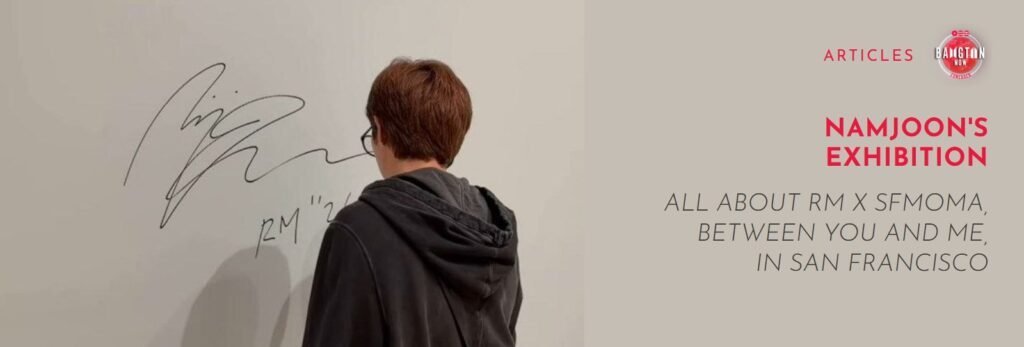
Right at the entrance of Namjoon’s exhibition, visitors are greeted by Namjoon’s dated signature, along with the sentence about seemingly obvious yet strange harmonies. He shared the photo on his stories himself. And, according to the press who were there, his handwriting appears at several points in the exhibition, with excerpts straight from his notebook notes. As someone who is always reading wall texts in museums, I promise you: that’s extremely rare. Most of them are by curators and printed.
The SFMOMA cake
There was even a cake. DESsert Avenue Bakery made a cake inspired by the partnership between Namjoon and SFMOMA, and it turned out gorgeous. I wanted a slice. Just a tiny slice.
Jean-Michel Othoniel’s visit
The French contemporary artist Jean-Michel Othoniel, famous for his giant glass bead sculptures, visited Namjoon’s exhibition and posted on his stories that he was very happy to be in San Francisco and see RM’s exhibition. When a real artist crosses the country to see a collector’s collection, my love, that says a lot about the collection.
ARMY on the sidewalk
The press preview of Namjoon’s exhibition was invitation-only. Even so, according to the San Francisco Chronicle, dozens of ARMYs stood on the museum sidewalk hoping to see Namjoon arrive. Two friends traveled from London just for the opening week, and one of them told the newspaper she studied curating because of Namjoon. I read that and thought: that’s the effect he has. There are people who enter the art world through the door he opened. And that’s no small thing.
A donation on the same day
And since Namjoon doesn’t know how to do just one thing at a time: on the same day, September 29, that his exhibition was presented to the press in San Francisco, he donated 100 million won to the National Museum of Korea, for the purchase of works and pieces for the museum’s collection. He has been the museum’s global ambassador since June 2026.
Namjoon and art: how we got here
For those just arriving in the fandom, it may seem like Namjoon’s exhibition came out of nowhere, but it comes from almost a decade of “Namjooning”, the nickname ARMY gave to his habit of strolling through museums, galleries and parks, always sharing everything on social media. And that’s going to become a book, ok? Someday I’ll tell you all about it, right, Maga?
In the speech, he said he started going to museums and looking at art carefully eight years ago. In other interviews, he had already said he started visiting museums during BTS tours, out of boredom. Look where boredom took this man.
Since then, his relationship with Korean art has only grown:
- In 2020, on his birthday, he donated 100 million won to the National Museum of Modern and Contemporary Art, Korea, so that out-of-print Korean art books could be reprinted and reach libraries and schools.
- In 2021 and 2022, he donated 100 million won a year to the Korean foundation that preserves and restores Korean cultural heritage located outside the country.
- In 2022, a sculpture by Kwon Jin-kyu from his collection was loaned to an exhibition at the Seoul Museum of Art. And he narrated the audio guide for the modern Korean art exhibition at LACMA, the Los Angeles County Museum of Art. In other words, his voice had already guided visitors through an American museum before.
- In 2025, at Art Basel, in Switzerland, he became a global ambassador for Samsung Art TV and spoke publicly about his dream of having his own space for the collection. Samsung Electronics, by the way, is among the major supporters of the exhibition at SFMOMA.
- In June 2026, he became a global ambassador for the National Museum of Korea.
And that’s just picking out the main points. Then comes October 2026 and Namjoon’s exhibition on SFMOMA’s seventh floor. It makes all the sense in the world.
How to visit Namjoon’s exhibition in San Francisco
If you’re going (and I envy you deeply, but in a healthy way – or not), here’s what you need to know before visiting Namjoon’s exhibition. The information below is what the museum had released when this article was published, so always check the official exhibition website before finalizing any plans.
Timed tickets
Namjoon’s exhibition requires a timed ticket for everyone, bought online. And watch out, because there’s a catch here: general museum admission does not include the exhibition. You need to book the specific ticket called “RM x SFMOMA + General Admission”.
On top of general admission, the exhibition charges an extra fee of US$10 on weekdays and US$12 on weekends and holidays. SFMOMA members don’t pay the fee, but they also need to book a time slot.
According to the museum, weekday tickets from October 5 onward are available, as well as weekends, except the first Saturdays. The members’ preview, from October 1 to 3, sold out in advance and had a “humble” virtual queue of about 10,000 people. No big deal.
Arrive on time and don’t leave early
Ticket holders need to arrive at their scheduled time, and you can’t leave and re-enter the exhibition. The museum says this is so that as many people as possible can visit. So go to the bathroom first. Seriously.
Encore Pass: for those who want to go back several times
SFMOMA created the Encore Pass, which costs US$75 and lets you visit Namjoon’s exhibition as many times as you want during the whole run, with access to the museum’s other galleries on the same day. It also comes with an exclusive gift, picked up on site only, and 10% off at the exhibition shop. For ARMY, who can’t watch anything just once, it’s practically tailor-made.
The exhibition shop
There’s an exclusive shop for Namjoon’s exhibition, on the 7th floor, and only people with an exhibition ticket can enter. Careful with your credit card.
Museum hours
- Monday and Tuesday: 10 a.m. to 5 p.m.
- Wednesday: closed
- Thursday: noon to 8 p.m.
- Friday to Sunday: 10 a.m. to 5 p.m.
Bring headphones
The audio guide narrated by Namjoon is accessed on your own phone, in English or Korean. Bring headphones and a charged battery. You won’t want to miss a word.
Frequently asked questions about Namjoon’s exhibition
If you skipped straight here (ugh), no problem. These are the questions most likely to come up about Namjoon’s exhibition.
Where is Namjoon’s exhibition?
Namjoon’s exhibition, RM x SFMOMA: Between You and Me, is on the 7th floor of SFMOMA, the San Francisco Museum of Modern Art, at 151 Third Street, San Francisco, California, United States. To get in, you need to book the exhibition’s specific timed ticket.
How long is RM’s exhibition at SFMOMA on?
Namjoon’s exhibition is open to the public from October 3, 2026 to February 7, 2027. Before that, from October 1 to 3, there was an exclusive preview for SFMOMA members.
How many works are in Namjoon’s exhibition?
Namjoon’s exhibition brings together 178 works: 142 from his personal collection and 36 from SFMOMA’s collection. The pieces range from a clay sculpture from around the 5th century to works by contemporary artists born in the 1990s.
How much is a ticket to Namjoon’s exhibition?
On top of general museum admission, Namjoon’s exhibition charges an extra fee of US$10 on weekdays and US$12 on weekends and holidays. SFMOMA members don’t pay the fee. Those who want to go back several times can buy the Encore Pass, for US$75.
Does Namjoon’s audio guide have a Portuguese version?
No. The audio guide recorded by Namjoon is available in English and Korean, and the two versions are different from each other, because they were recorded from two separate, unscripted interviews. Here on Bangtan Now, we summarize what he says in each part of the English version of Namjoon’s audio guide.
Can I listen to Namjoon’s audio guide without going to San Francisco?
Yes. SFMOMA made the full audio guide available on the museum’s website, with 11 tracks: the preface, one track for each section of Namjoon’s exhibition and the credits. You can listen in English or Korean, right in your browser.
Does Namjoon’s exhibition have a soundtrack?
It does. SFMOMA published the RM x SFMOMA playlist on Spotify, with 10 songs and 34 minutes, including tracks by Sanullim, Lee Sora and Ryuichi Sakamoto.
Will Namjoon’s exhibition come to Brazil?
So far, there’s no announcement of Namjoon’s exhibition traveling. SFMOMA says it’s the only presentation of the collection in the United States, and there’s no official information about other countries. If that changes, I’ll be the first to freak out here.
Who curated Namjoon’s exhibition?
The exhibition was curated by Namjoon himself, together with co-curators América Castillo, SFMOMA’s manager of curatorial projects, and Hyoeun Kim, the museum’s assistant curator of painting and sculpture. Namjoon chose the works, wrote the texts and recorded the audio guide; América Castillo was the one who proposed the exhibition, and Hyoeun Kim worked with him on selecting and organizing the rooms.
Between you and me
At the end of the speech, Namjoon apologized twice and came back to the microphone to say what he had forgotten: that the exhibition was an introduction of himself. That he hoped people could get to know him better there, because he felt there was a lot of him in those rooms.
And I think that’s what gets me so much. We spend years trying to understand who Namjoon is through song lyrics, through BTS, through interviews, through museum photos on Instagram, through solo albums, through little pieces he lets out here and there. And then he goes and practically hangs his own living room on a museum wall, writes each label by hand, records his own voice explaining what he feels in front of each painting and says: there, this is me. I can’t explain everything, but I like it.
Me, someone who lives between museums and BTS songs, I’ve never seen these two worlds so close to each other. And I’m still here, on the other side of the continent, with an absurd urge to walk through the door of Namjoon’s exhibition, up on the seventh floor.
Now tell me: if you could choose two works from this exhibition to see side by side, which would they be? And if you’re going to San Francisco, for the love of everything, come back here and tell me how it was.