

BTS No 29 is the track that made a lot of people take out their earbuds, shake their phones and replay the song about three times on March 20, 2026. It starts, a bell rings and then… nothing? Some thought the album had stopped playing, others doubted their own ears, and someone even asked whether it was a sound only people under 29 could hear.
No, there’s nothing wrong with your phone. Well, sort of: the problem kind of is your phone, but hang on, I’ll explain why in a bit.
What you hear in No. 29 is the sound of the Sacred Bell of Great King Seongdeok, a bronze bell cast in the year 771 that Korea keeps as one of its greatest treasures, ringing, resonating and fading away for one minute and thirty-eight seconds. And to me, this track is one of the most beautiful choices on the Arirang album, even though it lasts less than two minutes. The reason isn’t the sound of the bell itself. It’s everything behind this choice, and one of the coolest bits of storytelling BTS has ever done.
Put on your headphones (seriously, put them on) and press play:
What is BTS No 29?
BTS No 29 is the sixth track on Arirang, BTS’s fifth studio album, released on March 20, 2026 by BigHit Music. It’s a 1 minute and 38 second instrumental interlude made from a single strike of the Sacred Bell of Great King Seongdeok and the resonance that follows it. No vocals, no other instruments.
So if you came here looking for the lyrics or an English translation of BTS No 29, I’m sorry to say: there are no lyrics, so there’s nothing to translate. No pronunciation either.
The title of BTS No 29, by the way, comes from the bell’s former place on South Korea’s list of national treasures, where it was National Treasure No. 29.
And for an almost silent track, it made quite a lot of noise: it debuted at No. 11 on Spotify’s global chart on release day, with 6.5 million plays. Today it has passed 200 million streams on the platform, the first almost silent track in history to get there. And it was precisely the last song on Arirang to hit that mark, sealing the album’s record as the fastest release in Spotify history to have every track above 200 million.
BTS No 29 credits and track info
Track info for a track with no credits. Sounds like a joke, but there’s real information here:
No. 29
BTS · Arirang (2026)
| Album | Arirang (5th studio album, 10th overall) |
|---|---|
| Track number | 6 of 14 |
| Release date | March 20, 2026 |
| Recording | Sound recording provided by the National Museum of Korea |
| Length | 1:38 |
| Genre | Instrumental interlude |
| Label | BigHit Music |
| Credits | No songwriting or production credits |
| Sound | Sacred Bell of Great King Seongdeok, cast in 771 |
| Language | None, track has no lyrics |
| Video | No MV, only the official audio on the BTS – Topic YouTube channel |
The bell in BTS No 29: the Sacred Bell of Great King Seongdeok
To understand BTS No 29, you need to meet the owner of the voice. And what a voice.
Its official name is Seongdeok Daewang Sinjong, the Sacred Bell of Great King Seongdeok. It was commissioned by King Gyeongdeok, of the ancient kingdom of Silla, to honor his father, King Seongdeok. Gyeongdeok died before seeing the bell finished, and the one who completed the work was his son, King Hyegong, in 771, after more than three decades of attempts. Grandfather, son and grandson, all tied to a single bell.
After moving around several times (it was buried by a flood, spent time at a temple and on the Gyeongju city wall), it was sent in 1975 to the Gyeongju National Museum, where it still is today. The bell is 3.66 meters tall and weighs 18.9 tons. Quite the bell, huh. On top of that, it has more than a thousand characters engraved in the bronze and is the largest ancient bronze bell preserved in Korea.
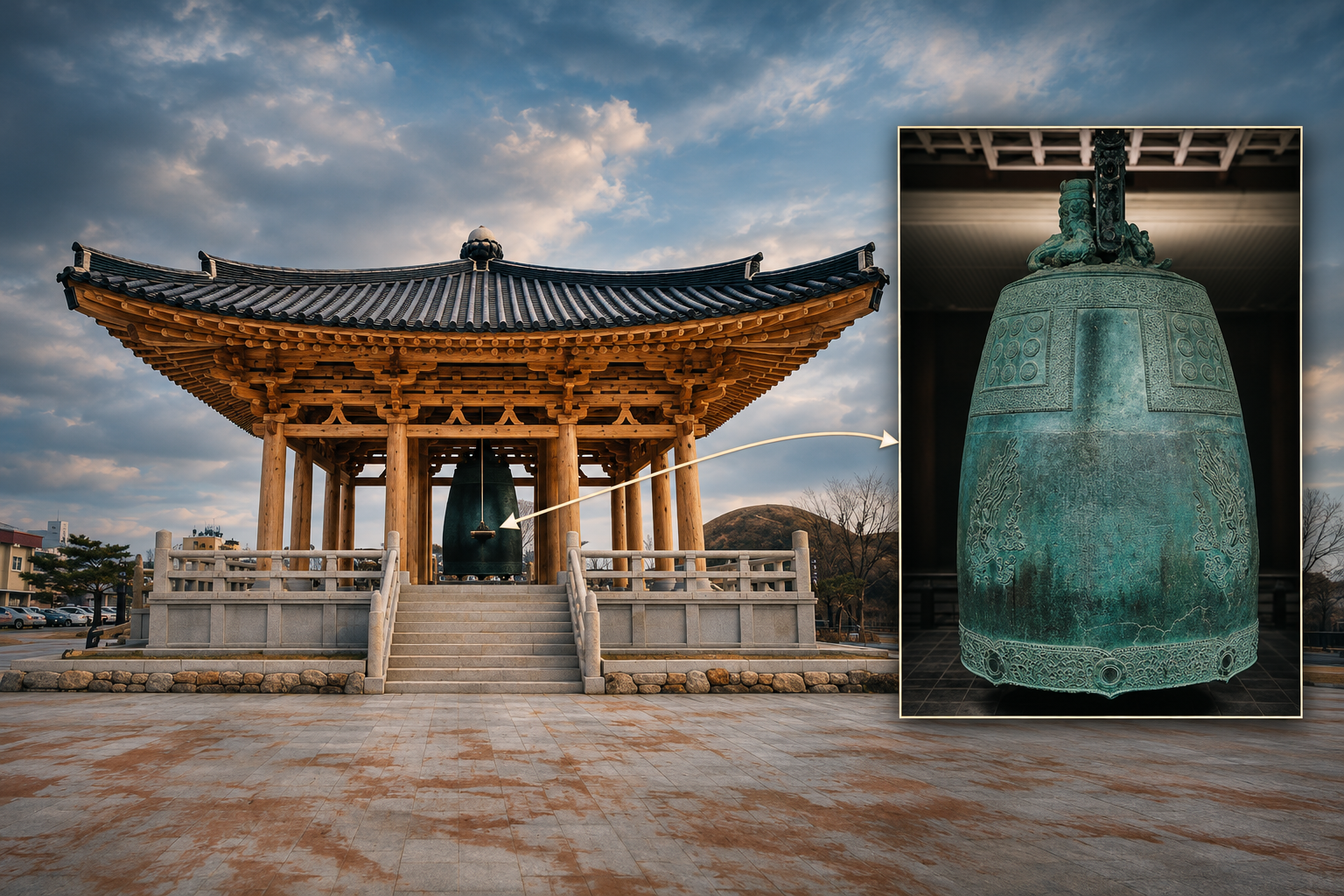
It’s also known as the Emille Bell, because of a rather dark legend: they say that after several failed castings that kept the bell from ringing properly, a child was thrown into the molten metal, and the bell started making a sound like “emille”, something like a child calling for its mother.
It’s a legend, of course, with no record in history books, and historians point out it was only written down in the 20th century, more than a thousand years after the bell was finished. But it caught on so well that, to this day, almost every Korean knows the bell by that nickname. We’ve got Bloody Mary, they’ve got Emille, and that’s fine.
What makes this bell so special is the sound it produces. When it’s struck, the vibration doesn’t vanish all at once: it grows to a peak and then fades in waves, an effect Koreans call maengnori (맥놀이), a kind of pulse that makes the sound seem to breathe as it disappears. That’s what you hear on the album. But here’s a tip: listen with headphones, because without them, the frequency it rings at makes the sound disappear much sooner.
The idea of putting the bell on the album came from Bang Si-hyuk, our well-known Bang PD. In October 2025, during a visit tied to the cultural partnership between HYBE and the National Museum of Korea, the museum’s director, Yoo Hong-jun, took Bang to hear the bell’s resonance. He walked out determined, took the idea to the members, and they were in. The audio on the track is a high-quality recording provided by the museum itself.
And the length has an explanation: in a live stream right after the release, Namjoon said the track lasts exactly as long as the sound of the bell takes to vanish completely after the strike. Not a second more, not a second less.
The meaning of BTS No 29
Even a track with no lyrics, like BTS No 29, says a lot, especially because of where it sits on the album.
What does BTS No 29 mean?
BTS No 29 is the turning point of the Arirang album. The bell separates the first half, where BTS takes the stage, proud, ironic, cheeky, and reminds the world who they are, from the second, where they step off it and talk about what weighs on them most away from the spotlight.
Let’s remember what came before. Body to Body, Hooligan, Aliens, FYA and 2.0 are five songs full of presence, sky-high ego and provocation, one after the other, peaking with FYA and ending in the loud, rhythmic hip-hop of 2.0.
Songs made “outward”, to be heard, almost spat at anyone who doubted their return and calling everyone to explode and catch fire. Then the bell rings. Everything stops. When the sound finishes fading, SWIM comes in, the title track, almost hypnotic, about simply not giving up and to keep swimming through life, and then the album changes temperature until the end, getting more introspective, going through Merry Go Round, NORMAL, Please and ending beautifully with Into the Sun.
In fact, the Bell of King Seongdeok is a beomjong (범종), the great bronze bell of Korean Buddhist temples, and it was made for the temple dedicated to the king. In temples, the bell marks time and signals that one part of the day has ended and another is about to begin. BTS took an object more than 1,200 years old and used it for the function it always had, only inside a pop album. I find that far more elegant than any synth interlude they could have recorded in a studio.
Where BTS No 29 fits in the Arirang album
There’s a delicious irony here that I can’t let slide. Body to Body opens the album asking you to put your phone down and be truly present. Five songs later comes BTS No 29, a track your phone can barely play properly without headphones, and that always makes you wonder whether Spotify just stopped out of nowhere.
The part of the sound the ear picks up clearly lasts around 20 to 30 seconds. The rest is a resonance so low that the phone’s speaker practically ignores it. To hear the whole track, you need headphones and attention. Exactly what Body to Body asked for.
I don’t know if it was planned this way (nobody from HYBE called me to confirm, though I wish they would), but in the voices in my head it makes a lot of sense, and the result is this: the track rewards whoever is paying attention and goes unnoticed by whoever is listening on autopilot. No pun intended with the bell. Or maybe intended. It makes you stop and reset for the rest of the album.
And then there’s the story of the bell itself, which speaks to the album in a way that gets me. A king starts a work to honor his father, doesn’t live to finish it, and his son completes it years later.
Arirang is the group’s first full-lineup album after their military service, made by seven men who paused everything in 2022 and came back to pick up where they left off. The bell went through two reigns before it rang. BTS went through almost four years of hiatus. This reading is mine, none of the members said anything like it, but it’s hard to ignore the parallel on an album named after Korea’s best-known folk song. I believe what suits me.
BTS No 29 fun facts
For a minute-and-a-half track, this interlude has a ton of stories behind it. Here are the best ones:
- It was left off the Billboard charts for lack of credits. Of Arirang’s 14 tracks, 13 entered the Billboard Hot 100 in debut week. The only one left out was BTS No 29, and not for lack of streams: everything suggests that a bell recording with no credited songwriter or producer ends up ineligible 😅. It also didn’t make the Global 200, while the other 13 took the top 13 spots on the Global Excl. US, a record for that chart.
- On Spotify, it charted alongside the rest. On release day, all 14 tracks on the album, the bell included, took the top 14 spots on the platform’s global daily chart.
- The number 29 is retired. In 2021, South Korea stopped numbering its national treasures, so as not to suggest that one cultural asset is worth more than another. In other words, BTS named the track after a number that officially doesn’t even exist anymore. I think that’s sweet, them keeping a tradition alive when not even the tradition is kept anymore.
- The bell almost never rings. Until 1992, it rang every year on New Year’s. After that, the strikes stopped for fear of cracks, and it only rang again for research, in 1996, between 2001 and 2003 and between 2020 and 2022. In September 2025, it was rung in public for the first time in 22 years, for 771 people chosen by lottery (the number of people really is the year the bell was finished, which I found very ritualistic). Its most recent ringing was in September 2026, with 12 strikes. The album audio, by the way, doesn’t come from any of these, since the album came out before: it’s a recording the museum already had.
- You can hear the bell in Seoul. On the 3rd floor of the National Museum of Korea, a sensory room called Between Spaces (공간_사이) plays the sound of the bell and lets visitors feel its vibration. That’s the room where Bang Si-hyuk heard the resonance alongside the museum’s director. The original bell is in the outdoor area of the Gyeongju National Museum.
- The bell became merch. The partnership with the museum led to an official line of BTS products inspired by the designs engraved in the bronze, like the offering figures and the clouds surrounding the bell.
- And it made it to London. In July 2026, the British Museum put together a route through its Korea gallery tied to the album, and one of the stops started from No. 29 to present pieces from the Silla kingdom.
BTS No 29 FAQ
Here are the questions people ask most about the track, with straight answers.
What is BTS No 29?
BTS No 29 is the sixth track on the Arirang album, an instrumental interlude made only with the sound of the Sacred Bell of Great King Seongdeok. It has no lyrics or vocals and lasts 1 minute and 38 seconds.
What does the name BTS No 29 mean?
No. 29 is the interlude on the Arirang album made with the sound of the Sacred Bell of Great King Seongdeok, a bronze bell from 771. The name comes from the bell’s former designation as South Korea’s National Treasure No. 29. On the album, the track marks the shift from the first half, focused on the stage, to the second, more personal one.
Does BTS No 29 have lyrics or a translation?
No. The track is fully instrumental: it’s one strike of a bell and its resonance, with no vocals at all. That’s why it has no lyrics, translation or pronunciation.
Why does BTS No 29 seem to have no sound?
BTS No 29 has sound from start to finish, but most of it is a very low resonance that phone speakers barely reproduce. The clearly audible part lasts about 20 to 30 seconds. With headphones and the volume up, you can hear the bell until the very end.
Who wrote BTS No 29?
BTS No 29 has no songwriting or production credits. The track uses a recording of the bell provided by the National Museum of Korea, and the idea of including it on the album came from Bang Si-hyuk, approved by all seven members.
How long is BTS No 29?
BTS No 29 is 1 minute and 38 seconds long. According to Namjoon, that’s how long the sound of the bell takes to disappear completely after it’s struck.
What was BTS No 29’s best chart position?
The track debuted at No. 11 on Spotify’s global chart. It’s also the first almost silent track in history to pass 200 million streams on the platform. It didn’t enter the Billboard Hot 100: everything suggests that, with no credits, it was considered ineligible.
One minute and thirty-eight seconds of near silence
On an album with Diplo, Mike WiLL Made-It and Kevin Parker on production, one of the tracks with the coolest role in the album’s storytelling has none of them. It has a bell that took more than three decades to finish, struck a single time, and a group confident enough to hand it 98 seconds of the comeback ARMY waited almost four years for.
Next time Arirang reaches BTS No 29, the sixth track, don’t skip it. Put on your headphones, close your eyes and wait for the sound to really end. Then tell me in the comments: did you also think your phone was broken? 😁💜
You may also like:
 2.0 BTS Lyrics: English Translation, Pronunciation and Meaning of the Song from the Arirang Album
 Aliens BTS Lyrics: English Translation, Pronunciation and Meaning
 FYA BTS Lyrics: English Translation, Pronunciation and Meaning of the Song from the Arirang Album
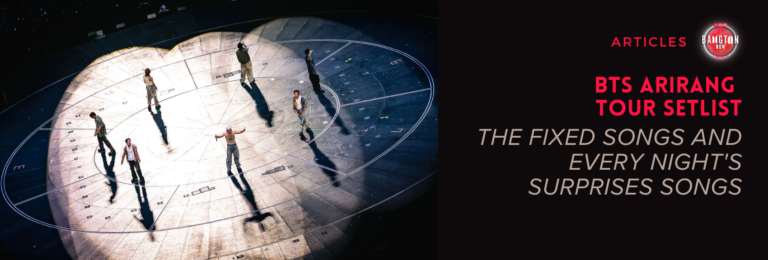 BTS ARIRANG Tour setlist: the fixed songs and every night’s surprises