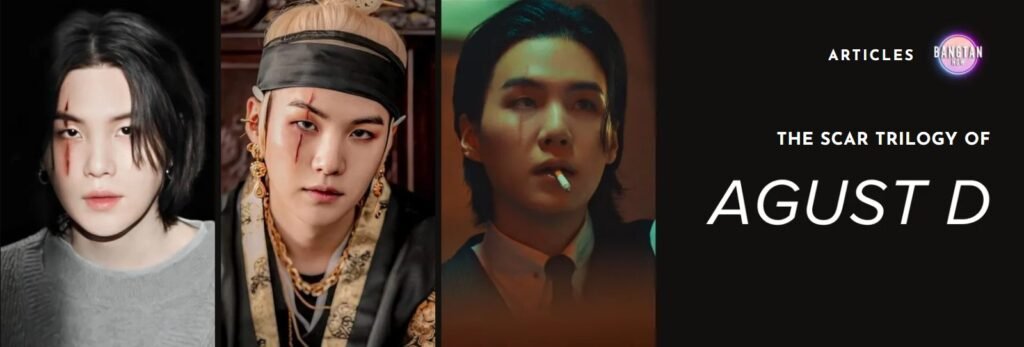
Have you ever stopped to think that the MVs for “Daechwita”, “Haegeum” and “Amygdala”, from BTS member SUGA‘s solo work as Agust D, could be a single work in the form of a trilogy?
That’s the theory behind Agust D’s Scar Trilogy — let’s dig in.
In this article about these three iconic works, we’ll look at a curious theory that was born the first time the scar over Agust D’s eye appeared, in the “Daechwita” MV. Let’s call it “Agust D’s scar trilogy”, okay?
But first, some context. I’ll risk sounding repetitive to longtime ARMYs, but we write for everyone, and new people join the fandom all the time (thank goodness!). So here’s a quick look back at SUGA’s career in BTS and the birth of Agust D. After all, we know nothing is random in their work, and this scar detail may have its roots in BTS’s early days.
Min Yoongi = SUGA = Agust D
He isn’t one. He’s many. We know SUGA of BTS well: rapper, singer, performer, songwriter, producer, dancer and owner of the cutest gummy smile on the planet.
ARMY is also a fan of SUGA’s solo version, who goes by Agust D, the hardest-hitting rapper in the East, with blunt lyrics that don’t hesitate to poke any wound, whether personal, cultural or social.
But he’s also Min Yoongi, a complex person who only lets himself be seen when he wants to.
Yoongi was born on March 9, 1993, in Daegu, South Korea. His passion for music must have been born with him, because he started writing and producing at 13. At 17, he wasn’t SUGA yet. Known as “Gloss” (I know, I know…), he worked part-time at a recording studio, doing mixing.
It was with this experience as a producer in the underground scene, and as an active part of the local alternative rap scene, that he learned what he needed to be accepted by Big Hit Entertainment (now HYBE) in 2010, after passing an audition.
He fit right into the plan of creating a group that made its own music. Alongside RM and the agency’s producers, he would form the first core of the group’s songwriting.
Watch trainee Min Yoongi’s audition for Big Hit, in 2010
We know BTS wasn’t an instant success. The formula was created through trial and error. It was supposed to be a hip-hop group. No wonder they had a super solid rap line made up of RM, SUGA and j-hope. On the vocal line, Jin, V, Jimin and Jung Kook. Everyone working hard to sing and dance perfectly, as the K-pop rulebook demands. Along the way, the concept shifted to something more pop. Our SUGA adapted, something he showed he could do with ease. In the following years he would become a hitmaker. Today, SUGA is considered one of the biggest music producers on that side of the world.
But back to young SUGA, lost in life. Okay, he just wanted to be a songwriter, but he was no fool. When he saw the chance to be an idol, why not? For Big Hit, even if he wasn’t the best singer and dancer back then, he had something that would make that specific group different: the ability to create. It’s true BTS wasn’t the first K-pop group to make its own music, but SUGA has always been a creative force no producer could pass up. Big Hit knew what it had when it grabbed the kid.
Along with SUGA came the person Min Yoongi. He’s not the most open member of the group, doesn’t like the spotlight, is a bit gruff, gives some pretty blunt answers in interviews or just wears that bored “someone get me out of here!” face.
In the beginning, he was the one with the least money. SUGA was a trainee at Big Hit, with no certainty he would debut. In the time left between training, rehearsals and creative work, he worked at a convenience store and did motorcycle deliveries. It went wrong. He had an accident that injured his shoulder. The right thing would have been surgery and a long recovery, but that didn’t happen because, along the way, BTS blew up. The schedule kept growing. SUGA performed in pain for years. He often needed anti-inflammatory injections before and after shows to get through it. The surgery only happened in 2020, during the break forced by the pandemic.
As SUGA (the name comes from “shooting guard”, a position in basketball, his favorite sport), he quickly stood out as one of the group’s thinkers and, of course, for his sharp, fierce rap. As a producer, his talent was used not only for BTS but for other artists too, like on “Wine”, by singer Suran, a 2017 hit that earned awards.
The Birth of Agust D
Long before the group’s break for the mandatory military service of South Korean men, SUGA had already created his alter ego Agust D. A simple acronym, but created to express complex, heavy things that SUGA couldn’t say as “SUGA of BTS”. The name Agust D comes from “DT” (Daegu Town, his hometown) and “SUGA” spelled backwards.
Agust D appeared in 2016, when SUGA released his first self-titled mixtape for free, to show a rawer, more personal side, far from BTS’s polished image. “Agust D” is visceral and I honestly recommend listening from start to finish. I just can’t promise you’ll come out in one piece. Besides fierce social attacks, SUGA as Agust D is painfully but necessarily frank, exploring themes like the struggle with depression, anxiety and the pressures of the music industry. It’s on this mixtape that we hear “The Last“. Keep that in mind.
His second mixtape, “D-2“, released in 2020, tackled broader themes like identity, freedom and sociopolitical criticism, showing his artistic maturity. Then in 2023, with the album “D-DAY“, SUGA closed his trilogy as Agust D, with a reflective look at his personal experiences and the fleeting nature of life.
Closing the album trilogy leaves the question that bothers ARMY: will SUGA “kill” Agust D? We simply don’t know. Personally, I believe Agust D will exist as long as SUGA needs him.
The Scar Trilogy MVs: “Daechwita”, “Haegeum” and “Amygdala”
But this isn’t an article about SUGA aka Agust D’s entire body of work — you could write a book on that alone. The focus is the possible “Agust D scar trilogy”, formed by three songs from his solo career: “Daechwita“, from D-2 (2020), and “Haegeum” and “Amygdala“, from his third album, D-DAY (2023). Whether this “scar” will lead to more, I don’t know, but so far — wow, SUGA, my dear, what was that?
Watching the MVs is important to understand the songs as a whole, trust me. It also helps to have the translated lyrics at hand or subtitles turned on. And it was in the MVs that the “scar trilogy” first appeared.
If we stretch things a bit, we can find a possible origin of an eye injury long before Agust D, in the “Run” MV, which has a fight scene between the members. Whether the idea for a sharper wound was born there is only a theory.
Daechwita in Agust D’s Scar Trilogy
The “Daechwita” MV, released in May 2020, was shot on a historical set. “Daechwita” is powerful right from the start. The word refers to a form of traditional Korean military music, and the first chords are basically a sample of that sound. From this MV on, Agust D always appears in the videos as two different people — watch how that evolves. Also notice the production design, the use of blue and orange, and the cinematography. These patterns repeat in “Haegeum”.
Watch the “Daechwita” MV to start understanding the scar trilogy
The first character to appear in “Daechwita” is SUGA dressed as a king, an arrogant being, lord of the historic palace. The second character, a “present-day” SUGA, will confront that established order. Both protagonist and antagonist have the scar cutting vertically through one eye. This repeats in the other videos of the “trilogy”.
The song basically tells SUGA’s story: a guy who came from nothing, made himself king and doesn’t care what people say about him.
What got me most was the clever repetition of a gong-like sound echoing through the whole song, under relentless beats and a shouted flow. It’s a constant clash between tradition and the present.
Song + lyrics + MV in one word? Rage.
The Role of Haegeum in the Scar Trilogy
Then we get to “Haegeum”, released in 2023 as part of “D-DAY”. Here things get even more complicated, but there are details in common with the previous work. To start, we have tradition vs. the present again, just like in “Daechwita”. “Haegeum”, by the way, is the name of a traditional Korean instrument.
Watch the “Haegeum” MV
Also in common with the “Daechwita” MV are the same blue and orange patterns in the production design and cinematography. And, of course, the scar is on Agust D’s face again, but this time only on the crime boss, the rival of the daring thief.
The word “haegeum” can also be translated as “lifting of a ban”, or liberation, and the complex lyrics go through freedom of expression as something that can even cost lives, the difference between freedom and self-indulgence, how the flood of information ends up restricting imagination, and how even freedom of thought is being violated. I’ll leave the interpretation to you.
The MV is “absolute cinema”. The opening scene, with Agust D as a John Wick–style assassin, is unforgettable.
Besides talking about freedom of expression, “Haegeum” is an anti-capitalist punch, which may sound strange coming from someone forged by the purest capitalism, Korean soft power. Make no mistake, K-pop is a cultural product and a tool of political power. Isn’t it ironic, though, that the freedom to say whatever he wants as Agust D only came after he established himself as a BTS idol? He knows that. And the best part is throwing it in everyone’s face with a super expensive MV, paid for by all that money, to say whatever he wants.
If up to “Haegeum” SUGA had established himself as the idol who made me stop and think, with “Amygdala” things took another turn. There are many possible reactions the first time you watch it: surprise, shock, tears. Consume in moderation. Agust D is getting dangerous.
Amygdala Closing Agust D’s Scar Trilogy
The “Amygdala” video is the most introspective of the three, exploring SUGA’s trauma and personal experiences. The tone is dark, and the video is full of symbolic scenes, like closing doors and tight spaces, representing the struggle against painful memories. The cinematography plays with light and shadow to heighten the emotional weight, while slow cuts and SUGA’s intense expressions deepen the connection with the viewer.
Watch the “Amygdala” MV
(This video is age-restricted because of its content; click the player to watch it on YouTube.)
“Amygdala” deals with sensitive topics. The MV opens with a trigger warning, something that has become standard nowadays. So, trigger warning from here on: we’ll talk about mental illness, pain and suicidal ideation. I didn’t start this, he did!
Unlike the furious raps of “Daechwita” and “Haegeum”, “Amygdala” opens with a soft voice, almost a moan, repeating in English that he doesn’t know “your” name. Unlike the blue and orange of the previous MVs, everything here is gray. There’s a feeling of helplessness and disconnection from the first seconds, and it only gets worse.
The song is about memories, and they’re not good ones: his mother’s heart surgery, his father’s cancer, the accident that caused him pain for years. But there’s redemption: the endless pain couldn’t kill him. It’s that Nietzsche thing: “What doesn’t kill me makes me stronger.” We get it, SUGA, we get it. He also sings about things he never wished for, things beyond his control. Yep.
Deep pain leaves deep scars. Or we end up opening those wounds ourselves. In the video, SUGA picks up a box cutter and, although it isn’t shown explicitly, it seems to me that the scar we saw in “Daechwita” and “Haegeum” is made here by himself, on his own face. Self-harm is no joke, believe me. The motorcycle accident is also shown, as well as alcohol and pills, capped off by a trip to the hospital ER.
The video is like the song. Straight to the point. When I first watched it, I didn’t need to understand more than that one English line to know what the song was about. It was a bit shocking. Honestly, you don’t expect something like this from a BTS member.
Okay, BTS has always talked about mental health, but always from a positive point of view. Problems exist, and you need to take care of yourself. But here it’s pure despair. Gray, unretouched.
The amygdala is real. It’s a small part of the brain that processes emotions related to fear and anxiety. It also stores our memories and triggers immediate reactions when we feel in danger. That’s who SUGA begs for help in the almost-shouted chorus, asking to be saved and taken out of there.
Although the lyrics show the possibility of learning through pain — the hope of having made the best choices, since it’s all in the past — the video doesn’t follow the same path. As always, there are two SUGAs: the one who survives the motorcycle accident and even tries to save the other, and the one who hurt himself and is trapped inside the apartment, unable to get out.
In “The Last”, from 2016 (remember I told you to keep that in mind?), SUGA had already talked about mental health problems, including depression, compulsion and social phobia. In the song, he talks about sometimes being afraid of himself, about “killing” the Min Yoongi he used to be, about his first visit to a psychiatrist with his parents — when none of them felt they really knew him — and about admitting to the doctor that he had already tried to take his own life.
An important detail. Although talking about mental health is increasingly common today, it’s still a huge taboo in countries like South Korea, where admitting to these illnesses means being seen as “weak” and, worse still for a man, less masculine. SUGA has been talking about it since he was very young, without fear. That alone deserves applause.
And the scars? What are you trying to tell us, SUGA? Honestly, I don’t know, but I can speculate. The order of their “evolution” is different from the order in which the MVs were released, which doesn’t mean the songs were created in that order. We know things don’t work like that.
“Daechwita” came first. The scar is very clear, very “red” and marked on both Agust Ds’ faces. In “Haegeum”, it’s almost healed on the face of the crime boss who is killed by the other Agust D. And in “Amygdala” it’s self-inflicted. Fresh, almost bleeding.
I’ll venture to say that “Amygdala” was the first song to be written, but that’s just my opinion. It may even have been an earlier version of the one we know. In fact, there’s a mention of creating a version of “Amygdala” in an episode of “In the SOOP”, when SUGA explains the song’s theme to Jimin.
SUGA explains “Amygdala” to Jimin
Anyone who makes art knows how it is. You don’t always create the final version right away. “Amygdala” may have literally been “cutting” Agust D from the inside long before.
Thank goodness it came out in the form of music, and it may have been the founding idea of the “scar trilogy”.
More Facts About the Songs of Agust D’s Scar Trilogy: “Daechwita”, “Haegeum” and “Amygdala”
Daechwita
- Lyrics and theme: a mix of personal pride, self-confidence and reflection on his journey.
- Charts: reached the top of several global charts, including Billboard’s World Digital Song Sales.
- Fun fact: the song blends traditional Korean instruments with modern hip-hop sounds, creating a unique, culturally rich fusion.
Haegeum
- Lyrics and theme: questions freedom of expression and social restrictions, encouraging listeners to reflect on mental prisons.
- Charts: debuted among the most-streamed songs on the Spotify Global chart and on the Billboard Global 200.
- Fun fact: “haegeum” is also the name of a Korean instrument, reinforcing the link between tradition and modernity.
Amygdala
- Lyrics and theme: deals with trauma, painful memories and the process of emotional healing.
- Charts: stood out on streaming platforms and was praised by critics.
- Fun fact: “amygdala” refers to the part of the brain related to emotions, reinforcing the personal, introspective nature of the song.
The Meaning of Agust D’s Scar Trilogy
Agust D’s scar trilogy isn’t just a sequence of MVs full of iconic scenes and flawless cinematography — it’s a true emotional breakdown wrapped in sharp rhymes and productions that leave us speechless. The scar? Well, it seems to be the visual signature of this trilogy, of a man who got tired of being nice and decided to expose his own wounds in a way we didn’t know we needed to see. But we did.
Each song delivers a different vibe: in “Daechwita”, we get Agust D in “war king” mode, full of rage and ready to take down everything and everyone. In “Haegeum”, he becomes the crime boss, questioning the so-called freedom that, ironically, everyone thinks they have. And then comes “Amygdala”, where he invites us on an uncomfortable walk through trauma and pain that many people would rather ignore — but not him, he wants to throw us headfirst into that emotional abyss.
Does the trilogy end here? Who knows. Maybe Yoongi has already moved on, maybe he’s fooling us and one day he’ll show up with another MV to mess with our sanity. Either way, the message was delivered: he does what he wants, how he wants, and we just watch, drool and say thank you.
So, what’s your interpretation of this genius work called Agust D’s scar trilogy? Share it with us in the comments, because this needs to be discussed!